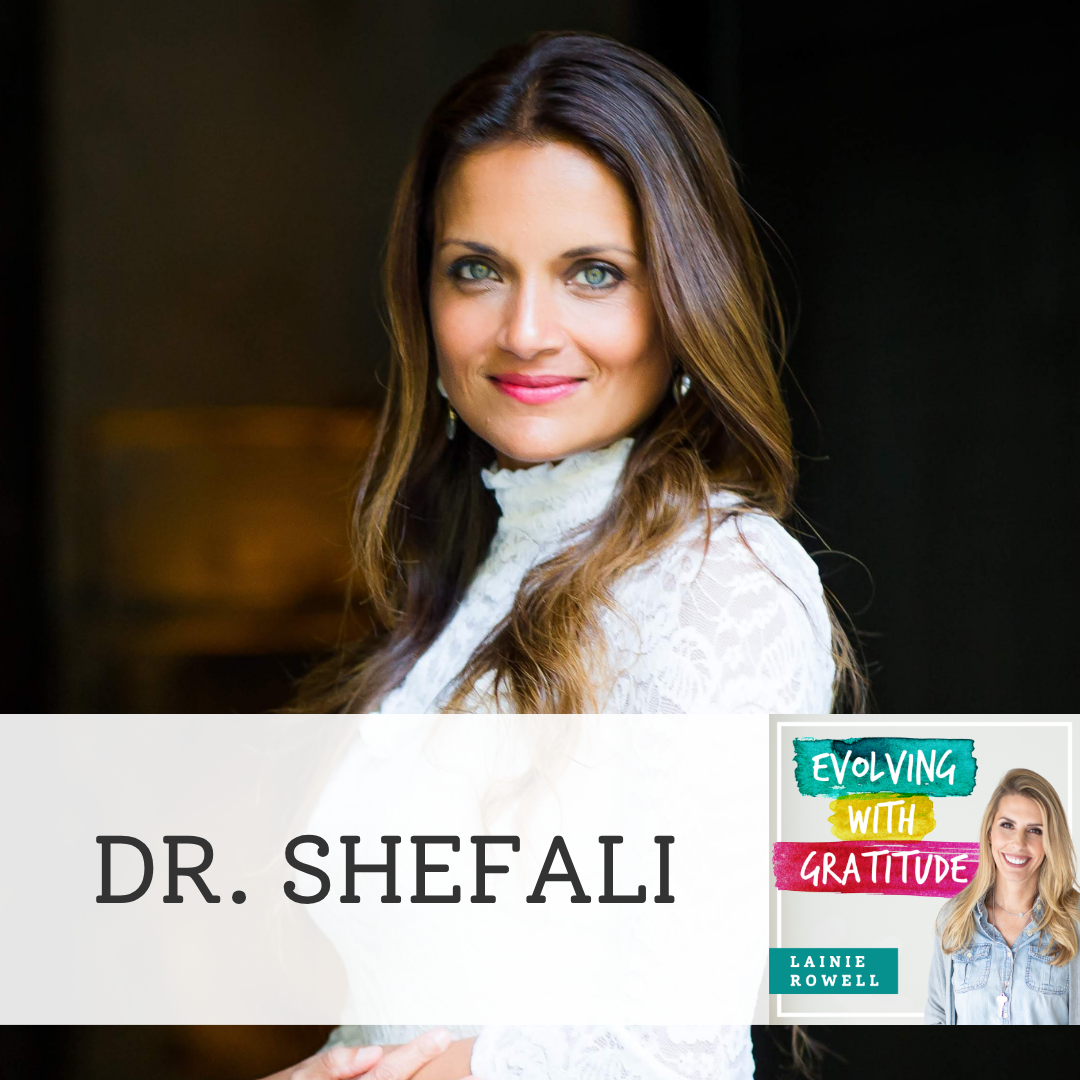
Shownotes:
What does it look like to raise kids who feel worthy as they are?
In this episode, clinical psychologist and bestselling author Dr. Shefali Tsabary joins me to explore Raising Conscious Sons and Raising Conscious Daughters, including trust, boundaries, technology, and helping kids become more fully themselves.
“Accept the child you have, not the child of your fantasy or the child you wished you had.”
Thrive Global Article: Dr. Shefali on Raising Conscious Sons and Daughters
About Our Guest:
Dr. Shefali is a clinical psychologist, a New York Times bestselling author, and the founder of the Conscious Parenting movement, redefining how families understand selfhood, connection, and the inner life of children. She works where psychology meets consciousness, tracing the hidden forces that shape identity, relationships, and the way we inhabit the world. Trained at Columbia University, she has spent decades guiding families to move beyond patterns of control and fear toward presence and authenticity. Her work brings Western psychology and Eastern wisdom into lived practice, creating a path for children—and the adults who raise them—to know themselves fully.
About Lainie:
Lainie Rowell is a bestselling author, award-winning educator, and TEDx speaker. She is dedicated to human flourishing, focusing on community building, emotional intelligence, and honoring what makes each of us unique and dynamic through learner-driven design. She earned her degree in psychology and went on to earn both a post-graduate credential and a master's degree in education. An international keynote speaker, Lainie has presented in 41 states as well as in dozens of countries across 4 continents. As a consultant, Lainie’s client list ranges from Fortune 100 companies like Apple and Google to school districts and independent schools. Learn more at linktr.ee/lainierowell.
Website - LainieRowell.com
Instagram - @LainieRowell
LinkedIn - @LainieRowell
X/Twitter - @LainieRowell
Evolving with Gratitude, the book is available here! And now, Bold Gratitude: The Journal Designed for You and by You is available too!
Both Evolving with Gratitude & Bold Gratitude have generous bulk pricing for purchasing 10+ copies delivered to the same location.🙌
Just fill out the forms linked above and someone will get back to you ASAP!
Transcript:
Transcripts may contain a few typos, so I appreciate your grace in advance!
[00:00:00] Dr. Shefali Tsabary: I'll tell you one of the most powerful ways to create trust, in my opinion, very underutilized, is show up as a parent who is self-aware of their imperfections. I always tell women who are dating Listen for your date, whether they are giving you clear signs that they are aware, self-aware of their shadow, of their deficiencies, of their ego.
[00:00:29] And a person who comes across as I'm so conscious, I'm so amazing, I'm the best, is a dangerous person. .
[00:00:36] Welcome to the Evolving With Gratitude podcast. I'm your host, Lainie Rowell. I'm an author and speaker, and I'm here to help you optimize happiness, relationships, and performance. Clinical psychologist, New York Times bestselling author, and founder of the Conscious Parenting Movement, Dr. Shefali argues that there's a mismatch at the heart of modern parenting.
[00:00:57] The world our kids are growing up in has [00:01:00] changed faster than the way we parent them. She works with parents every day, and she says what she keeps hearing is the disconnect and helplessness. So she wrote two new books to help parents close that gap.
[00:01:13] They arrive as a pair, Raising Conscious Sons and Raising Conscious Daughters. Here's our conversation. Enjoy
[00:01:20] Lainie Rowell: Dr. Shefali, welcome to the podcast.
[00:01:23] Dr. Shefali Tsabary: Thank you. Thank you for having me, Lainie. So, so grateful to be here with you.
[00:01:28] Lainie Rowell: Well, I am very excited for this conversation, and I've, I've got so many questions. There's no way we'll get to all of them. First of all, I have a boy and a girl, so I appreciate that you wrote a book for each of them, and I'd love to know more about why specifically the two books, why Raising Conscious Sons and Raising Conscious Daughters now? Why these two books, and why together?
[00:01:54] Dr. Shefali Tsabary: Yeah, great question. It, the, it's really a very important [00:02:00] point that you're making. Why did I write them now, and why did I write separate books?
[00:02:04] So let me just address that. You know, I, I wrote these books because I sensed the cultural emergency. I work with parents, I deal with people all the time. It's my business, my practice, my life, my purpose. And I began hearing so much discontent in parents, so much helplessness. And then I see the statistics and the mental health crisis in our children, and you begin to realize, wow, parenting has really stayed the same, but the world has changed, so we need to adapt our parenting right away. It's urgent. I give parents a blueprint. So one book is called Raising Conscious Sons, and one is called Raising Conscious Daughters. And I really went back and forth. Should I put them both in one book? Should I just make it about children? But the reason I separated them, not to reduce our children to sex and not to u- underestimate the beauty of gender fluidity, but- [00:03:00] To really honor and celebrate and respect our differences.
[00:03:03] Lainie Rowell: Mm.
[00:03:04] Dr. Shefali Tsabary: You know, uh, women know who are in menopause that we are different. And if you go all the way back, then our boys and girls are different. And guess what? Culture treats our boys and girls different, but then technology and the algorithm treats them as different. Mm. So when parents don't realize how the algorithm is abducting your boy differently than the girl, you don't know what to look out for.
[00:03:29] You don't know how to intervene in a way that matches their wiring. Boys and girls have a very distinct neurochemistry, bio- biochemistry, a hormonal rollout, and we need to be aware, okay, this is what happens to a boy in puberty inside his body. This is what his brain needs. This is what his sexuality is going to look like on the main.
[00:03:52] And I give a step-by-step blueprint for parents. These are the red flags, look out for this, and this is how you deal with [00:04:00] self-harm, body dysmorphia, anorexia, uh, porn, sexuality, the brotherhood, the loneliness. I've talk- tried to talk about every issue. I interviewed over 100 kids, and so I have data that comes from real-life experience
[00:04:17] Lainie Rowell: Is there something that, as you've written many books and as you've been diving into this and interviewing, is there something that changed for you in your thinking throughout that process?
[00:04:27] Like, maybe you went in with a hypothesis and something i- through investigating actually came out differently?
[00:04:33] Dr. Shefali Tsabary: Yeah. I knew that our children were in trouble. I didn't realize how much trouble, and that they are really sinking, and they need a life raft. And I learned so many things about all the issues I didn't know.
[00:04:50] Mm. I didn't know, for example, that on social media there are trends for self-harm. Like, like people are suggesting, "Oh, if [00:05:00] you're feeling too much anxiety, do this. Cut yourself." And it's in the dark web, and it's underground, but it's there. There are trends for anorexia. There are trends for body dysmorphia.
[00:05:10] And children are vulnerable, not only to predators, but to ideas, to concepts, to fake news. And I just became very struck and aware that we are hurtling down a path of increased isolation-
[00:05:27] Lainie Rowell: Mm ...
[00:05:27] Dr. Shefali Tsabary: and warped reality. You know, I talk about the false reality syndrome, which is really how we each have our own false realities.
[00:05:36] At least back then when we were growing up, we all had the same false reality. Now, we each have our own false reality, and that's even more separating and disconcerting.
[00:05:48] Lainie Rowell: That can feel very isolating, right? Yes. And that different people are experiencing different false realities. What is a tip that you would give ... You know, I, I come from the [00:06:00] perspective of I don't think that all technology is inherently evil. I think technology can be used for good. It can also be used for some pretty nefarious activities. What is your advice to parents about how to approach, and I think the key might be with nuance because they, you can make these universal rules and, you know, I, we all have our ideals.
[00:06:24] Like, my kids don't get on social media until they're, you know, much older. But then, like, we have schools that put all the sports stuff on Instagram, and if you're not on Instagram, you don't know what's happening in school. And so there's just, like, I'm getting really specific,
[00:06:41] but, what are the, the guidelines that you would give for parents about how they can really have these conversations so that- There's not things happening in secrecy, 'cause that's another thing we know about kids, is that if we tell them, "You can't do this," they're gonna maybe find a way to do this.
[00:06:59] And so [00:07:00] what, what's your advice there?
[00:07:02] Dr. Shefali Tsabary: Oh, my goodness. You know, it is incredibly difficult. I think we should have a few blanket rules, like no smart screens till your kids are teens at least. That's an easy one. And then when they are teenagers, you know, you cannot let them disappear into their rooms, and try to have screens in common areas, in public areas.
[00:07:25] And be aware of the need for real good digital hygiene and boundaries. Make your kids earn the screen time. Make them, uh, have consequences when agreements are broken. Uh, and consequences are not punishments, but things that they get to contribute more to the neighbors, or mow the lawn, or e- every time they violate the screen time, they have to kind of do something for the home, for the community.
[00:07:50] And I think the greatest tip is don't take away the screens cold turkey. Uh, provide things to replace it with first. [00:08:00] Mm-hmm. Uh, increase your connection. Make sure your kids are moving. Make sure your boys are outdoors, and physical, and tired, and sweaty, and exhausted. Mm-hmm. You know, overdo the other things so that then the screens just become an add-on in their lives.
[00:08:15] But in many of the children that I interviewed, they were on screens four or five hours a day because they did not have that wider net of activities or community to fall back on. And then that, that's when it becomes really dangerous.
[00:08:29] Lainie Rowell: I appreciate that, yeah. And, and I have to say, just as a parent, um, I, I don't let my kids take devices into their rooms.
[00:08:37] And, like, if I did, I would never see them. You would never- It would like
[00:08:41] Dr. Shefali Tsabary: Yeah.
[00:08:42] Lainie Rowell: Really good advice that you're upping the other activities instead of, uh, just talking about taking this away.
[00:08:48] So you're finding replacements. Are there other universal needs that we need to think about for daughters versus sons or boys versus girls? Like-
[00:08:57] Dr. Shefali Tsabary: Oh my God, there are universal needs, [00:09:00] yes. So let's talk about boys. Simply put, uh, if you want them to have emotional regulation, they need to have motion.
[00:09:08] So motion is for emotion, meaning exhaust them. For every task you want them to do, make it an adventure, make it an obstacle course. If they have to brush their teeth, they have to look for the toothbrush. If they have to, uh, go to school, they have to find their shoes. A- and I know this sounds like extra work, but let me tell you, they'll do it much faster if it's a challenge, a test, a game, a sign for, you know, competency and competition.
[00:09:34] That is the male psyche. For girls, it's very important that you understand that she's ruled by estrogen and oxytocin, which make her relationally very attuned, very sensitive. She picks up relational cues, eye movements, the jaw clenching, the sigh, the s- the emoji. I mean, she's reading everything everywhere, and she's picking up on her sense of self, and she is plagued by how [00:10:00] people see her.
[00:10:01] I call it the perception prison, where she is so worried and obsessed by people's perception of her. So we don't wanna call her dramatic. We don't want to, uh, dismiss her anxieties. We want to allow her the safe space to talk. We don't want to focus on her beauty and her appearance. We want to teach her about not objectifying herself.
[00:10:23] We want to empower her to have a voice and to f- be authentic, not just a good girl.
[00:10:29] Lainie Rowell: Mm. That's oh, this is gonna be-
[00:10:34] Dr. Shefali Tsabary: Just- This is a- Just, just do these 25,000 things and you'll be okay.
[00:10:39] Lainie Rowell: It's hitting home with me because there's a part of me as a mom who wants to tell my daughter how lovely she is, but then I don't want her to, focus on how her appearance is.
[00:10:48] It's a tough thing being a parent, right?
[00:10:51] Dr. Shefali Tsabary: Especially today. Especially today because we're doing it less and less in real community, and we're doing it more and more in a virtual community. [00:11:00] So even if we were unable to give the good messages, let me tell you, she is absorbing all the toxic messages from culture.
[00:11:09] You may not give a single toxic message, and in the past if you were a non-toxic parent, you were a great parent. You're like, "Yeah, I'm winning. I didn't say anything mean to my daughter today." But today, whether you say mean things or not, or you judge her or not, it doesn't matter because social media by its nature is bec- has become a trove of trolls who are judging you all the time.
[00:11:33] So y- you know, just by fact that people can readily comment on your, on your m- on your Facebook page or your Instagram page just is an invitation for disaster when it comes to pre-pubescent and pubescent girls. Because their identity hasn't yet formed, and yet people, strangers are telling her who she is and who she's not.
[00:11:53] Lainie Rowell: Mm-hmm. So what do we do as parents to counter the ... I mean, obviously we, we need to [00:12:00] have the good digital hygiene and manage on that, and have the open dialogue with our kids. Is it, what else could we be doing to help counter the things that are out of our control?
[00:12:11] Dr. Shefali Tsabary: Oh, my goodness. We have to bring up things at home.
[00:12:14] Yeah. "Oh, guess what? You know, all of these images are filtered. All of these images are AI. All of these images are fake," number one. Number two, talk about the manosphere. You know, talk about Andrew Tate and other influencers who are poisoning our boys' minds. Discuss it. Let's, let's bring up a topic Andrew Tate talked about.
[00:12:34] Do you agree? Do you not agree? Mm. Every, every other day you can do a boy issue, a girl issue, and that's why my two books are so wonderful because you have lots of issues here to talk about. Um, talk about self-harm. "Hey, did anyone in your school ever talk about harming themselves? I, I know somebody who cut themselves."
[00:12:51] Then talk about cutting. And your kids may say something like, "What a ridiculous idea." And you go, "Yeah, I know. It, it, it is. But it can be understood, [00:13:00] and let's talk about it. Like, if you ever feel so anxious that you feel the need to cut, would you come to me?" "Yes, Mommy, I'd come to you." "Okay, good, because I would like you to."
[00:13:10] So in, in, in lots of indirect ways, if you can counter-effect the, uh, poison of, of these platforms, you can at least make them savvy consumers.
[00:13:22] Lainie Rowell: Yeah. And it sounds like you're, you're really promoting that open dialogue in a way that, we don't wanna make them afraid to come to us. Exactly. Because if they feel like they can't, if we're not that trusted adult, we're not gonna get the inside on what's happening.
[00:13:37] Dr. Shefali Tsabary: 100%. If we're not the trusted adult. So how do we create trust? We create trust in some very unusual ways besides the typical ways. The typical ways is you, you know, you listen, you validate, you don't judge, you provide safety, you don't criticize. We know that. We know that, but it's very hard to do. But there's another way to create trust.
[00:13:59] I'll tell [00:14:00] you one of the most powerful ways to create trust, in my opinion, very underutilized, is show up as a parent who is self-aware of their imperfections. I always tell women who are dating Listen for your date, whether they are giving you clear signs that they are aware, self-aware of their shadow, of their deficiencies, of their ego.
[00:14:28] And a person who comes across as I'm so conscious, I'm so amazing, I'm the best, is a dangerous person. The person who knows their shadow and the beasts that live there is a person who will not let the beasts out.
[00:14:42] Lainie Rowell: Mm.
[00:14:42] Dr. Shefali Tsabary: The person who thinks they have no beasts, it means that they don't realize that they have the beasts, but they've just suppressed the beasts.
[00:14:50] The beasts will come out i- in the dark. And the best humans to me are those who are very humble- Mm ... in the face of their [00:15:00] ego and are willing to talk about it. And that's how trust is built. I trust you because you're taking ownership, you're taking accountability, you're looking at your co-creation. You're not just a dumping-and-running parent who's just telling me it's always my fault.
[00:15:16] Um, a person who doesn't take themselves so seriously, doesn't get so defensive. These are trustworthy, worthy things because then I know if I come to you, you're not gonna be all, you know, self-righteous and defensive. You're gonna be like, "Really? Did I do that? Oh, man, did I do that? Oh, geez, I'm so clueless."
[00:15:36] Um, I think that's very refreshing for children, and they feel they can come to you with their imperfections.
[00:15:44] Lainie Rowell: You're modeling that self-awareness- Yes ... and that is what is going to build the trust, if I'm understanding correctly.
[00:15:51] Dr. Shefali Tsabary: It is. It is. It's, it's a surprising way, but if you think about it, you know, the reason we get drawn to people the most is [00:16:00] because they are in touch with their story, in touch with their, their vulnerabilities.
[00:16:05] That makes our heart open to them.
[00:16:09] Lainie Rowell: So as we're talking about these universal needs, we kinda touched on it earlier, but I wanna talk about it again because I just, I anticipate you get people who push back and say, "No, no, no, my son's not like that," or, "No, no, no, my daughter's not like that."
[00:16:22] Yeah. These are generalizations. So what do you say to that when someone comes at you with something like that?
[00:16:28] Dr. Shefali Tsabary: That's why I wrote both books at the same time. Read both. You may find your son more in the daughter's chapter, uh, in one of the daughter's chapter, and the daughter more in the son's. You are not supposed to be a cookie cutter parent to a cookie cutter child.
[00:16:41] I've given you the general, in the main, bell curve. But your kid could be an outlier in one or two things. Your son could be the best communicator in the world. Yeah. Your daughter can be the one who says, "I don't know," and never cries. Uh, ultimately, our children come as they are, [00:17:00] and culture then interacts with who they are.
[00:17:02] But who they are in their essence comes, comes kind of factored in. Yeah. And I always tell parents, accept the child you have, not the child of your fantasy or the child you wished you had.
[00:17:15] Lainie Rowell: Yeah. Okay. So if ... I, sorry, I like to repeat things back to make sure I understood it. So it sounds like generally speaking, these are the universal needs of a boy, these are the universal needs of a girl.
[00:17:30] But that does not mean that your specific child is going to fall into just one of these. Is that fair?
[00:17:36] Dr. Shefali Tsabary: Oh, my goodness. 100%. It's not categorical, it's just guidelines.
[00:17:41] Lainie Rowell: Yeah.
[00:17:43] Dr. Shefali Tsabary: It's actually good to read the book and go, "Oh my goodness, my son is not in these pages at all." Then you pick up the daughter's book and you're like, "Oh my God, he's in chapter nine, he's in chapter six, he's in..."
[00:17:54] And that's okay because a- all of us ultimately are on a continuum, but we do come [00:18:00] preloaded with certain neurochemical wiring. I'm trying to honor both realities.
[00:18:05] Lainie Rowell: Let's talk a little bit about boundaries, and how do we ... And speaking of continuums, right?
[00:18:12] Oh, boy. Like, when it comes to the freedom we give versus the boundaries we enforce, like, how do we manage that with our kids? Like, what is the best approach to that as we're ... Especially, like, I, again, I'm bringing a lot of myself into this interview. I don't usually, but it's like, I have a 12, almost 13-year-old boy, and I've got a 15-and-a-half year old daughter.
[00:18:34] So I mean, I'm in it, Dr. Shefali. I am in it, so s-
[00:18:39] Dr. Shefali Tsabary: Oh my God, I can imagine. And the schools don't make it easier, do they? Because they send everything on the computer. Now, how are you gonna monitor the kid when he's doing his homework, right? How?
[00:18:51] Lainie Rowell: Well, we do it in a ... It has to be in a central, like in the kitchen.
[00:18:55] We basically do it in our dining room because, yeah, we like, we like to see the screens they're on. [00:19:00]
[00:19:00] Dr. Shefali Tsabary: Excellent, but that is a key strategy. Yeah. It's a key intervention to keep the screens in public spaces. Also, um, you know, besides controls and stuff like that, boundaries really are about understanding the danger.
[00:19:16] When you understand the danger, boundaries become really easy. Mm-hmm. Right? You understand the danger of your kid going out on the street when he's five years old on his own. You don't have to create a boundary. You, it's just intuitive. So boundaries- Get naturally created when you fully buy in to the consequence.
[00:19:36] But if you haven't bought into the consequence or you understand the consequence but you're like, ah, hoping, hedging a bet that it may not happen, then you, you flimflam, right? Then you are wishy-washy.
[00:19:48] Lainie Rowell: Okay. So what about other boundaries? And I'm thinking about, I, I'm gonna, I'm gonna tell you there are a lot of times in the real world where [00:20:00] boundaries come out, not just with screens, right? So like how do we manage, um, letting go of control, this is probably a, a theme you're catching with me, and, um, allowing s- and I'll talk specifically to the boy for just a minute, for them to have those opportunities to build their confidence.
[00:20:20] That's where I always think it's a little bit tricky, right? Like where's the-
[00:20:23] Dr. Shefali Tsabary: Do you have a good example of real life example?
[00:20:25] Lainie Rowell: Oh gosh. I want-- I didn't wanna make this too personal but like I've got a, I've got a kid who loves to ride his e-bike. Man, he loves that e-bike. And w- and what do I love?
[00:20:35] I love that he's out in, in the world. It's a, it's a hybrid. He's still pedaling, you know, pedal assist, whatever. Um, but oh man, like how far do I let him go? And what if he decides he wants to go further? And like I know this is a very specific example, but I'm, I'm being selfish right now. Help me.
[00:20:54] Dr. Shefali Tsabary: Oh my goodness, let me tell you, it's a really good thing that you got him an e-bike and that [00:21:00] he's out there in the wild and that he's exploring his body and the limits and taking risks and having adventures and falling down.
[00:21:07] What is our fear? Tell me the biggest fear you have. Is it the hospital? Is it a broken body? Is it a, you know, worse than that? Is it a predator?
[00:21:16] Lainie Rowell: Oh, I can catastrophize all day. Not really predator. Mostly like him getting hurt or hurting someone else.
[00:21:23] Dr. Shefali Tsabary: Okay. Uh, s- so you're gonna have to take that risk, you know?
[00:21:28] You're going ... It's the same as, you know, giving him access to the train system and letting him go on the subways alone in New York City. At 13, he, he should be allowed to do that, but anything can happen. He can fall in the tracks. He can- Mm ... get lost. So if it's not too dangerous, I don't know what an e-bike is.
[00:21:48] Is it like a, a real vehicle?
[00:21:51] Lainie Rowell: Oh, no. He's too young to have like a ... There's different classes, and they- Okay ... go so fast. Like, a, e- his e-bike can't go more than 20 miles an hour, although he would really [00:22:00] like to modify it to go faster. No.
[00:22:03] Dr. Shefali Tsabary: I think it's a great thing. I think it's a blessing for him. It gets out his adrenaline.
[00:22:08] It gets out his testosterone. I would say, you know, helmet him up, you know, buckle him up, and, you know, whatever, pillowcase him up, wrap him in a sheet if you need to, but he should be outdoors, and he should be wild, and he should be free.
[00:22:22] Lainie Rowell: Let's talk about girls for a minute. I love how you talk about building girls' inner authority.
[00:22:28] Dr. Shefali Tsabary: Mm-hmm.
[00:22:28] Lainie Rowell: Can we talk a little bit more about that? A lot of us have heard of that statistic of, like, if there's a job and it says, "These are the requirements for this job," like, a woman has to feel like she has 100% of them before she'll apply for it.
[00:22:41] A man, it's something like, eh, maybe half. And so, like, how do we build up our, our girls so that they, they have that trust in themselves?
[00:22:49] Dr. Shefali Tsabary: Oh, my goodness, what a great question. Because culture is so predatory to girls' inner authority and abducting of their [00:23:00] voice and their right to exist in their big selves and their, to take up space and to have a power and governance and, um, and real triumph in their presence, we need to overdo it in the house in the early years.
[00:23:17] And the father is very important here. The father, as a representation of the outer culture, needs to allow his girl to be the boss and, at, at, at times. Allow his girl to lead him, allow his girl to be fearless with him so that she knows, "Oh, men don't get upset with me. Men, men, uh, listen to me.
[00:23:38] My father is putty in my hands." It, now, when men hear this, they take it to mean disrespect, and I got a lot of flack for it recently on another interview because the men were like, "Oh, she's, she's espousing disrespect and defiance," and I wasn't. I was saying that when a father is particularly allowing of his [00:24:00] daughter to stand up to him, she gets to practice how to stand up in the toxic patriarchy outside.
[00:24:08] Um, so we want to help our daughters have that inner authority, give them space to listen to themselves, to express themselves, and this could be very uncomfortable for the parent because now you have to deal with your daughter's big mouth. But it is such a good practice for them. It, you know, giving your children safety, both of them, but especially your girls because they find the outside world so unsafe at times.
[00:24:34] It's such a flex you're giving them, such a power move you're giving them.
[00:24:39] Lainie Rowell: Anything that we need to be thinking about specifically for boys that we haven't already talked about? So if the girls, we're thinking about, like, that inner authority, what's the thing for the boys that we need to be extra cautious about?
[00:24:54] Dr. Shefali Tsabary: I think for the boys it is- Don't confuse [00:25:00] them into who they should be. Don't tell them they can't be like girls or they should be more sensitive. Don't tell them that they need to be like these masculine caricatures of like a Popeye, like a full muscle. Don't tell them that they need to be some way to be masculine.
[00:25:19] Mm-hmm. What they need to be is true to themselves. Mm-hmm. And allow them to feel honored for who they are and not become this mask or this persona, and pretend to know what it is like to be masculine. Also, honor their masculine energy. Don't try to suppress it. Get to know them.
[00:25:39] Lainie Rowell: Mm.
[00:25:39] Dr. Shefali Tsabary: Teach them about their sexuality.
[00:25:41] Uh, teach them that their bodies are not shameful and their sexual desires are not harmful unless they don't learn to integrate them. Teach them what that looks like. Teach them what sexual consent looks like. Yeah. And how to respect a woman or a man who you may be in a relationship with. [00:26:00] Educate these boys about their body.
[00:26:01] Lainie Rowell: For someone who wants to implement conscious parenting, like, what are, like, a couple of practical things they can do right away?
[00:26:10] Dr. Shefali Tsabary: You can- The most important things are the most simple. Begin to really listen to your child. Put the phone down, make eye contact, don't say a word. Ask them, "Do you want advice or do you want me to just listen?"
[00:26:23] Lainie Rowell: Yeah.
[00:26:23] Dr. Shefali Tsabary: Uh, do not judge them. If you want to tell them that they need to do something better, say to them very clearly, "This is not about who you are, it's about what you're doing."
[00:26:33] Um, you know, be very, very attuned for their feelings and allow their feelings to be expressed safely. Give it space. Don't make them your therapist and don't overdo the Sharing of adult information because it can often feel like a burden to the child. And lastly, have good digital boundaries. Have a good, clear system of when they use the iPads, [00:27:00] when they use the phone, where do they use it, how long do they use it for, where, when, how?
[00:27:05] And keep to it. Keep it consistent.
[00:27:09] Lainie Rowell: I wanna highlight something that you said in all of that which was lovely and, um, very actionable, so thank you for that. I love that you explicitly said separate the action from the, maybe the action that we're not happy about with who they are.
[00:27:24] So you're saying- Mm ... "I, I don't like that you did this. It is not who you are." So- Exactly ... would that be something kind of like, um, rather than saying, "You're rude," uh, saying, um, "That was rude." Like that, what you just said- Yeah ... was rude. You're not a rude person, but what you- Right ... just said is rude. Is that-
[00:27:44] Dr. Shefali Tsabary: Right, uh, but when you're dysregulated, it's very hard, so you do the shorth- shorthand.
[00:27:49] "You're always rude," right? Versus- Mm ... you know, "Whenever you say that, you're rude. Oh, it's so hard to, to use your words," right? But that's what we need to do is, uh, "I [00:28:00] know you don't mean to be rude, but that came across as very rude." Right? That would be the best thing. So you're even showing them that we understand that their intention is not to be rude.
[00:28:09] Lainie Rowell: We know that was not their intention. That is really, really helpful. I know I need to start wrapping up here, but what is something that you cannot say enough? The thing that you would wanna shout from the rooftops.
[00:28:21] It's the thing you either haven't had a chance to say on here, or it's you already said it on this interview and you just can't say it enough. Like, what's the one thing you really want people to hear from this work?
[00:28:33] Dr. Shefali Tsabary: I think parents need to wake up. Parents have power and influence. I'm empowering you in these books.
[00:28:40] Do one thing from every chapter once a week, just that, and you will save your children's lives and the connection to them. Parents have more power than they think. Their children need them more than they realize. And if parents just felt empowered and had the permission, they could turn the negative [00:29:00] influences of technology in their children's lives.
[00:29:03] Lainie Rowell: What is something that you hope for young people if all of these things are implemented?
[00:29:08] Dr. Shefali Tsabary: You know, the children feel empowered, that they feel worthy as they are, uh, and that they, you know, live their lives unencumbered by the opinions and values of others.
[00:29:20] Lainie Rowell: Dr. Shefali, how can people stay in touch with you? When this comes out, the books are live. Like, go to Amazon, you can grab your copies. What are other ways they can stay connected to you and your work?
[00:29:31] Dr. Shefali Tsabary: So these are the two books, I just put them up because they're colorful, people can find them.
[00:29:35] Raising Conscious Sons, Raising Conscious Daughters. Uh, go to drshefali.com. Upload your receipt, whatever you, wherever you bought the book, and then you'll get free masterclasses, you'll get a summit, you'll get, uh, access to my community. So lots of free gifts on my website. Also, if people want to learn how to do this work and become the best, most conscious parent ever, I have a flagship program for [00:30:00] five months in my Conscious Parenting and Life Coaching Institute.
[00:30:03] I've trained over 1,400 coaches to do this work on themselves and others. And I also run retreats. I have a retreat in Bali in November. If, uh, there's a woman out there listening who's going through a hard time and really wants to have me time with a good, beautiful group of women, then come on over to Bali.
[00:30:23] Lainie Rowell: I'll be sure to put the link to your website in the show notes so people can access that really easily. And Dr. Shefali, I really appreciate this time, and thank you for challenging us to be the best parents that we can be. And I didn't mean to make it about me, but you gave me a lot of really practical advice that I can apply, and I know those listening can as well. So really
[00:30:46] Dr. Shefali Tsabary: appreciate it. Thank you for having me. Thank you.
[00:30:48] Lainie Rowell: Yeah. Thanks for listening.
[00:30:49] If you're grateful for this episode, please be sure to subscribe today. And if you're feeling really thankful, please submit a review and share with others so they know the value. One last thing, [00:31:00] please connect on social media using the hashtag EvolvingWithGratitude to share your gratitude stories.