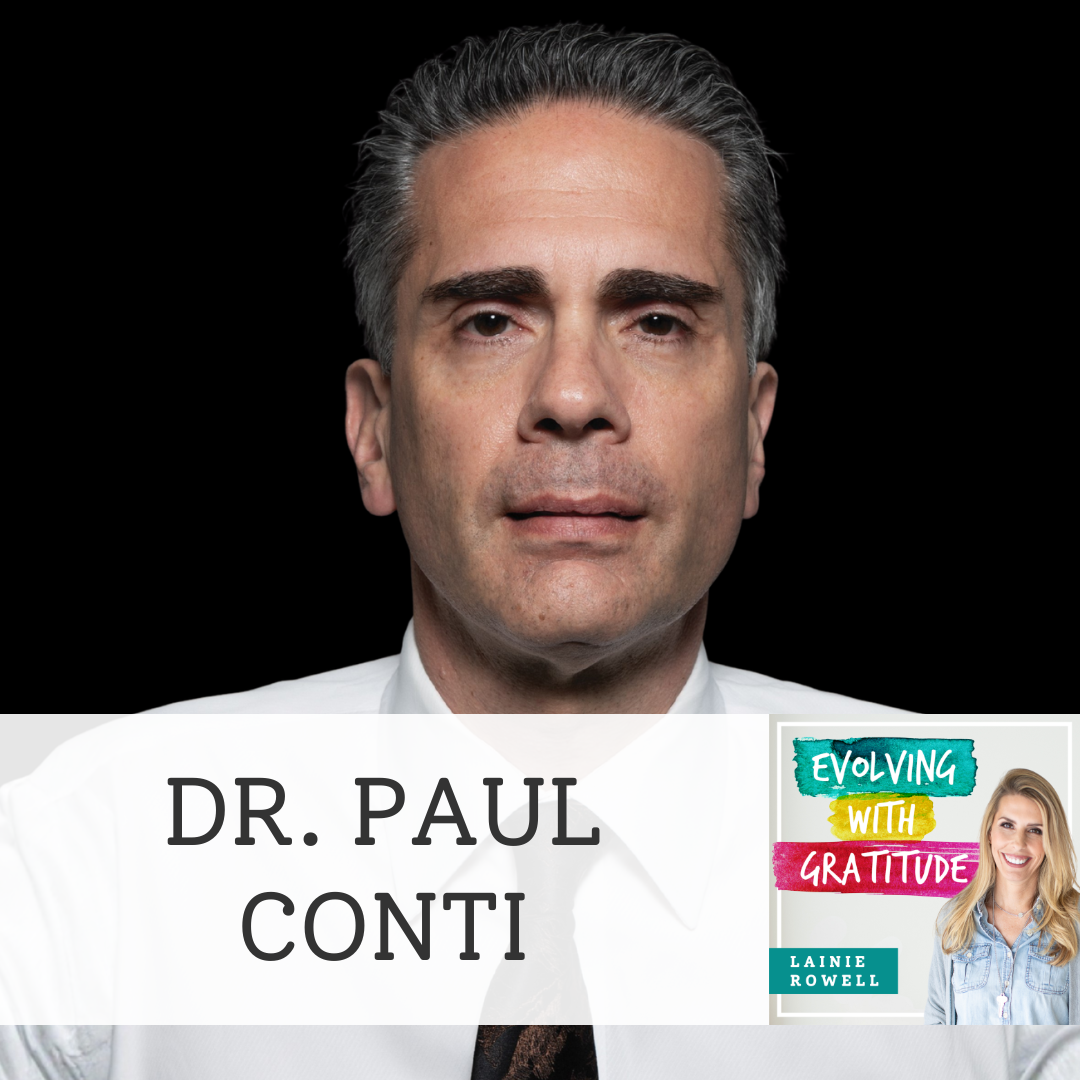
Shownotes:
What if mental health could be strengthened the same way we strengthen physical health, with understanding, structure, and small steps that help us move forward?
In this episode, psychiatrist and author Dr. Paul Conti shares a hopeful and practical way to think about mental health through his new book, What’s Going Right: A Powerful New Method for Optimizing Your Mental Health.
We talk about the generative drive, why agency and gratitude belong together, and how noticing what is going right can help us build a truer, healthier story of ourselves.
Thrive Global Article: Dr. Paul Conti on What’s Going Right
About Our Guest:
Paul Conti, MD is a celebrity-endorsed psychiatrist, renowned author, and President of Pacific Premier Group PC. He has been featured on top podcasts with industry-leading hosts such as Peter Attia, Tim Ferriss, Andrew Huberman, Mel Robbins, Lex Fridman, Whitney Cummings, Tom Bilyeu, Rich Roll, Danica Patrick, and others.
About Lainie:
Lainie Rowell is a bestselling author, award-winning educator, and TEDx speaker. She is dedicated to human flourishing, focusing on community building, emotional intelligence, and honoring what makes each of us unique and dynamic through learner-driven design. She earned her degree in psychology and went on to earn both a post-graduate credential and a master's degree in education. An international keynote speaker, Lainie has presented in 41 states as well as in dozens of countries across 4 continents. As a consultant, Lainie’s client list ranges from Fortune 100 companies like Apple and Google to school districts and independent schools. Learn more at linktr.ee/lainierowell.
Website - LainieRowell.com
Instagram - @LainieRowell
LinkedIn - @LainieRowell
X/Twitter - @LainieRowell
Evolving with Gratitude, the book is available here! And now, Bold Gratitude: The Journal Designed for You and by You is available too!
Both Evolving with Gratitude & Bold Gratitude have generous bulk pricing for purchasing 10+ copies delivered to the same location.🙌
Just fill out the forms linked above and someone will get back to you ASAP!
Transcript:
[00:00:00] Dr. Conti: you can't be at your best today for whatever happens tomorrow. Right, because tomorrow will bring new life. When can you be at your best tomorrow?
[00:00:10] When it's tomorrow. Right? So the idea is be as healthy as you can today. That's optimizing now. And it puts you in the best place to optimize tomorrow, to be at your best tomorrow. Whether good news comes or bad news comes, whatever it may be, it, it sets us up for being at our best tomorrow. And again, I do think that's the beauty of life.
[00:00:29] And a lot of times the world around us tells us, Oh, we want fast results. And then like that thing's done and we don't have to look at it anymore. I do not want my generative drive is at the best place it's going to be right. You know, cause that means there is not a tomorrow, right?
[00:00:42] I want a tomorrow that challenges me in one way or another. Take the goodness that's come in the, in the new news between today and tomorrow and make it even better or use that goodness to be good for people around you. And if bad news comes, well, take that bad news in and be the best you can be, right?
[00:00:58] So, so by being at our [00:01:00] best today, we set ourselves up for tomorrow. That's how we're optimizing and living through the generative drive.
[00:01:06] Welcome to the Evolving With Gratitude podcast. I'm your host, Lainie Rowell. I'm an author and speaker, and I'm here to help you optimize happiness, relationships, and performance.
[00:01:18] Hello, friend. What if the deepest force inside us isn't aggression or pleasure seeking, but something far more hopeful? Dr. Paul Conti believes it is and he thinks leading with it could change everything. Dr. Conti is a psychiatrist and the author of Trauma, the Invisible Epidemic. He joins us in this episode to discuss his latest book, What's Going Right? A Powerful New Method for Optimizing Your Mental Health. And this takes on one of the biggest gaps in our culture, the way we approach mental health. Now his message is clear and accessible. And what he really wants us to understand is that we can build [00:02:00] good mental health the same way we build good physical health with understanding, knowing the structure and the small steps we need to move forward. Enjoy Dr. Paul Conti.
[00:02:13] Lainie Rowell: .
[00:02:13] Welcome Dr. Conti. Thank you so much for being here.
[00:02:16] Dr. Conti: You're welcome. Thank you for having me.
[00:02:18] Lainie Rowell: I'm very excited about this conversation. I've read the book cover to cover and I so I'm going to hold up the actual physical book, but I just got this yesterday. My my copy that I had the advance copy, has a lot of post -its and a lot of highlights, but just so excited to talk to you about this. So your first book, Trauma, The Invisible Epidemic, you know, how did we get from there to this book, What's Going Right?
[00:02:44] Was there something in that process that brought you to this? Things you've learned between now and then? Yes.
[00:02:49] Dr. Conti: Yes. First, I thank you for the time and thought and effort that you put into the, the book and all those markups and sticky tabs. I appreciate that. And, and, and the [00:03:00] thought then of linking the first book, you know, or how does the first book relate to the second is, you know, the, the first was based on this observation that, wow, most of what I'm doing is anchored in trauma, right?
[00:03:11] Which is a really significant point. You know, conclusion to come to, because people present, we're all humans and we have different issues, right, that we bring. So to see, oh, there's something underlying the majority of this, like what makes depression worse, or substance use, or anxiety, or insomnia, or whatever it may be.
[00:03:31] So, so the, the real primacy of trauma as a driving force. for problems, issues in our lives. I worked through in the first book and that helped me also become much clearer about, oh, why are we not understanding this, right? Why, why are, why don't we have a system that helps people understand?
[00:03:49] We're, we're not doing something in mental health that's done in physical health. And the, and the, you know, the overarching message is we can build good mental health [00:04:00] just like we build good physical health, right? But we have to have understanding, right? If we talk about physical health, like we all kind of know that we have heart, lungs, brain, muscles, joints.
[00:04:11] We, like, we can't understand there's something there and then we don't have to understand all about it, right? We have to be a cardiologist to understand our heart, right? But we, we know the basics of it, and that's what lets us go through a process of understanding where a problem might be, right? And we need the same for mental health.
[00:04:29] Then we would come to, oh, this is trauma. Like, it's what we were, what I was doing in working with people in trying to get to the answers, right? There's a process that can be done. So just like physical health, we can apply something and say, well, let's do this. And, you know, the chances are we're going to figure it out.
[00:04:45] This out, right? And, and, like with physical health, it might be really quick, it might take a little bit of time, but, but there's a process we can go through, and that gives us understanding, and we use that understanding to make change, and, and I want us to be able to see [00:05:00] that in mental health, and it was that thought and set of ideas, like, wow, okay, this is where it leads me, is, we have to put forth, how do you get that understanding, and how do you make that process of change?
[00:05:09] Lainie Rowell: And you're taking something that is complex and dynamic and giving it some, some structure so that we can understand it and like you said, we don't necessarily have to be a cardiologist, but we know what the heart is, we know what the heart does, and to be in tune with that. Is that fair to say?
[00:05:26] Dr. Conti: Yes. I believe it was Albert Einstein who said to simplify things as much as you can, but not more.
[00:05:33] Right? And, and that's the goal here is to say, of course, it's extremely complicated. We're, we're human beings, right? We're, we're all infinitely complicated in, in many ways. So, so, we say, okay, how do we take that and simplify it to a, a, a structure? That we can engage in and to say, hey, this structure could help me understand myself.
[00:05:53] You understand yourself and everyone else understand themselves just like a process of taking a [00:06:00] history, doing a physical exam, getting labs. That's the right thing for anybody who's presenting with with a physical health issue that we we do that for mental health. And, and that then is game -changing both for individual people, right?
[00:06:13] And it's game -changing, I, I hope, I wish it to be game -changing on a big, on the bigger stage of how is mental health approaching helping people? Like how about a paradigm that lets us understand and bring change, right? If we simplify it to that, that can go in a, in a book. It's simplified enough that I think any, any of us can understand it, but it's not over -simplified.
[00:06:34] And, and a lot of what mental health does is... The, the field has no, no leadership in, in, in terms of how we, what are we doing here? What is mental health bringing to people? What it often does is there's different voices of oversimplification. Well, you know what the answer to it all is? It's CBT. It's cognitive behavioral therapy.
[00:06:54] No, that's a tool, not an answer so there's so much oversimplification, even [00:07:00] medicines, throw medicines at everything. Right, so the systems want to oversimplify, but that doesn't work. I, what I've tried to do in the book is take something complicated and simplify it enough that we can all get it. Right, but not simplify it so much that
[00:07:14] we're leading people astray, which is often what the field of mental health is doing.
[00:07:18] Lainie Rowell: Yeah, I truly, as a reader, felt like it was very accessible, but not to the level of oversimplification. So, I really appreciated that. And one of the things that, I mean, this is not a long enough podcast. to have the whole conversation about the book that I would love to have, but I really want to make sure we talk about generative drive.
[00:07:38] Something you said in the book. You're talking about the quality of your life, and you say, "The key to success is recognizing and nurturing the supremacy of the generative drive." So can you tell us what is the generative drive?
[00:07:51] Dr. Conti: Yes. So I'll start with, historically, the, the mental health field has seen humans as having two inborn drives.[00:08:00]
[00:08:00] Like, if you're human, then you have this. And it, it, historically was called aggression. It's really just assertiveness. But instead of saying assertiveness, it's not an accident, it was called aggression. Right? So aggression and, and pleasure seeking. And what has come to pass is we've, we've built our understanding of humans based upon this
[00:08:19] this way of looking at things, which makes no sense. It doesn't make any sense. It doesn't explain why we're still here. I would say, That if we really think about it, if all we had was, was assertion and aggression, like I, I wanted the world to, to, to shift and, and bend to my will, to what I want from it.
[00:08:40] And I want pleasure, and that pleasure might not, it doesn't just describe things that we, we think of as giving us pleasure. You know, vacations, food, sex, those kinds of things. Pleasure can also be like the pleasure of safety, having a roof over our heads, right? So, but if it's just that, it doesn't explain.
[00:08:58] Why we're still [00:09:00] here and it doesn't explain anything that's best about humans, right? So it doesn't explain altruism. It has to bend and twist around and say, Well, if you're altruistic, you just want to feel good about yourself because you can be altruistic, you know? That doesn't make sense. People are altruistic because they're altruistic.
[00:09:16] Why, why, why? Why would a person do that? There has to be some other explanation. Or why, why create art? Or why do something that makes the world a little bit nicer? You know, you see sometimes a person who's straightening something up out, or is taking rocks out of a pathway where bikes are going. Why do that?
[00:09:33] Right? If it's just aggression, I want to assert myself in the world, and I want things that are pleasurable to me. I wouldn't do that, right? So, so it's, it's, it's painfully obvious, but it's painfully obvious by observing humans and just looking at literature and philosophy across hundreds and hundreds of years and looking at what psychology has learned and what modern neuroscience tells us to say, no, that's not the answer.
[00:09:57] Right? And that what sits above it is the generative [00:10:00] drive. It's the drive in us to be in the world and make it a better place. It's the drive in us to say, yes, if you're on the ground, I'd like to offer you a hand up. Because that's human. If there's something I can do that makes the world a little better, more beautiful, that's, it's what we want to do when people don't want to do that there's a cynicism, there's something that's kind of beating us down, so the generative drive is not at the forefront. And this has been thought of before, the field, The field hasn't embraced it. Like I want to think I'm doing novel things in the book, but it's not all novel, right? Some of what I'm doing is just looking at what we already know and say, let's bring this to the forefront because there is no leadership.
[00:10:43] And how do we understand ourselves? And we need that. It needs to be based in truth. So we all have a generative drive. If we see that sitting above everything. And if we're paying attention to that, then the other drives will come into line. I will neither be too assertive, which then can make me [00:11:00] overly aggressive, nor will I be under -assertive, where I, you know, I'm just kind of giving up and learned helplessness, for example, right?
[00:11:06] I will seek the pleasure of good things in my life. I won't seek too much pleasure at the expense of other good things, like my health or relationships, or seek too little pleasure because I have no, no anticipation that good could come of it, right? So the assertion and pleasure drives can get very out of alignment in us, and very often do, right?
[00:11:28] But if we're governed by the generative drive, then we keep everything in line, and there's a structure of self and a function of self, just like there's a physical exam and there's labs and history taking. There are things to think about and do, right? But if we do those things, Then our drives are in balance.
[00:11:44] Why? Because if we're healthy, our generative drive is, is leading the way forward.
[00:11:49] Lainie Rowell: You mentioned structure of self and function of self. And is it fair to say structure of self is like what we think and function of self is what we do? Is [00:12:00] that, is that oversimplifying?
[00:12:02] Dr. Conti: Yes. No, I think it's, I think it's a good simplification.
[00:12:06] It says, look, we're all human beings, so we have a human mind, right? So, so that, so one way of looking at that is to say, well, what's inborn in all of us, right? And we say, well, we all have these three drives, okay? Another thing to say is there's a structure, right, of self, of mind, just like there's a structure of body.
[00:12:25] Okay. Right? It's predictable. There's a heart. There are two lungs. Right? There are muscles. We can predict that. We say that's, humans have that. Right? So humans have a structure of self. That's just how the mind is structured. And then the function is, yes, how it works. So we know that the body has a structure and we're very interested in that.
[00:12:43] But we're also interested in how it works. Okay, you've got one heart. How's it working? Right? So there's a structure, and then there's a function, and just, again, with physical health, if we look through the structure and the function of our physical selves, we're gonna be able to come to an understanding [00:13:00] of why we're having a problem or an issue somewhere.
[00:13:02] And even better than that, then we can build good physical health for the future. Right? In case, you know, something comes our way. We get sick. I mean, things happen, right? And if things don't happen, I want to be at my physical best today, tomorrow, and the next day. Then we're able to do that with our mental health, too.
[00:13:20] And say, let's build good mental health like we build good physical health. How do we do that? We have to understand the structure of our mind just like we have to understand the structure of our bodies if we're going to have good physical health. Then we also have to understand where it functions. So let's go there.
[00:13:33] That's what's undergirding, right, how the drives are functioning. And how the drives are functioning are then impacting the structure and the function of self. So we can go look at that. And I know I'm, I'm... I don't want to belabor the point, but it's just like we do with physical health. And that's the, the, the key to all of it.
[00:13:51] And that's the key to the difference between recoiling from mental health, right? Because of stigma or a fear, right? I would like for [00:14:00] mental health to be seen the same as physical health. Where if someone said, Uh, you know, someone you just kind of know, say, how you doing, or how's your, how's your physical health, how you taking care of yourself, exercising, diet, like we say that to one another as people, and we don't get scared by the question.
[00:14:13] We can talk, oh, I'm doing this or that, I'm working out and exercising a little, I'd like to do a little more of this or that, but mental health leads people to recoil. How's your mental health? Now I'm like, well, you know, but it shouldn't be like that. It should be the same as it is with physical health of, well, I can look at my mental health and saying, here's what I'm doing.
[00:14:31] That's good and healthy. And here's what I'd like to be different. Now we're not afraid. We're not confused. We're, we're not feeling stigmatized, right? We just understand I can talk about this. Why? Because it's, it's in every human and I want to understand it and build good health as best I can. Just like with physical health.
[00:14:50] Lainie Rowell: Well, the way that you're explaining it is making me think how... Generally speaking, it does seem that when physical health gets brought up, there's not [00:15:00] necessarily an automatic to the negative side of it. It's maybe more of a neutral, but when the phrase mental health comes up, there's kind of already a leaning towards the negative that there's probably problems or we're here to identify problems.
[00:15:15] Dr. Conti: I would say that, just, I would say that even more dramatically though. I think the way that the physical health has come along, there is a comfort, and in a lot of situations, an interest about that. If people know one another, there's an interest in talking about how I'm taking care of my health and, and discussing that, learning how you're taking care of your health and, and then, oh, like, we both can learn from that conversation.
[00:15:37] And, and there's a comfort to it because we become more comfortable talking about our physical health and understanding our diet, exercise, sleep. These things matter, so we can talk about them. So I think sometimes it's neutral, often it's positive
[00:15:50] to talk about physical health. And I think in mental health, it's often not just a little bit negative, but it's seen as very negative to broach the subject [00:16:00] of, of, um, mental health because again, we don't have a way of understanding and then we just feel afraid and people know, Hey, there's things in all of us that we might want to be different or better.
[00:16:10] And, but if we don't know how to do that, we get kind of deer in the headlights. And I think that's because there isn't leadership in the field to say, why should our mental health be different from our physical health? We're one being, right? The mind and the body are connected. Like we are one. Why would we take one part of it?
[00:16:26] And say, oh, that's a black box we're scared of. And I think that's taking a very big toll on us as individual people and as a population. It's no secret that our mental health as a population is not getting better. And yes, there are difficult things going on in the world and all sorts of reasons, but that's the bottom line fact, right?
[00:16:45] So we need to do something different. What we're doing now isn't working, and it makes sense that it's not working, because it's not telling us how to understand and how to bring change, so then we get scared of it, and we're, we're, we move more away from looking at our mental health when there are [00:17:00] more stressors and more ways that, um, All of us are at risk.
[00:17:04] Lainie Rowell: So would you say that when your generative drive is optimized, I don't know if you like that word or not, but when the generative drive is optimized, and, and you can never have too much generative drive, I've heard you say, that, that's like, that's the peak of mental health. Is that correct? Am I getting that correct?
[00:17:24] Dr. Conti: Yes, if, if your generative drive is running really, really high. And I think it's beautiful that, that something that can, we always can have more of, doesn't have a place where it's optimized, right? Because there's always more goodness to have, but isn't that great? Like, life, you know, continues forward and, and we're living each day striving towards more goodness in our lives.
[00:17:47] I think it's great that there's not a place to get where we're optimized, right? And, and often we kind of have that thought in life. We can get ourselves somewhere. Now we're there. We don't have to do anything. No, we're an evolving project. Every one of us, right? One day [00:18:00] after the next. So it's good that there's no optimal.
[00:18:03] Or you could also say what optimal is, is what's the most of it I can have today. Right? And if we look at it that way and we say, if that's where we're living, We're in good shape. Because what are we going to see underneath of that? We're going to see a structure of self that's healthy. We're going to see a function of self that's healthy.
[00:18:19] Just like if we see someone and we say, Wow, look at that, look at that person, how they're functioning physically. They're functioning great. A person just did all this, they ran a half marathon and they're like, they're up and they have energy and they're doing things in their life and they're with their family and friends like, Wow, look at their health.
[00:18:34] Right? We, we, we want to be able to look at that and say, yeah, if that's going on, the person's going to be in balance. They don't have a big heart problem, right? They don't have, they're not short of breath. They're not 40 pounds overweight. They won't be able to do these things, right? So, so if we're leading from the generative drive, then you can, you can see that everything underneath of it is healthy.
[00:18:55] And then everything underneath of it that's healthy supports the generative [00:19:00] drive staying in the driver's seat. And just like our health can spiral downward. And people's health can spiral downward. They stop exercising, gain some weight, feel bad about themselves, then compensate they're not eating as well, they're sleeping as well, then they gain more weight, don't feel good about themselves, cholesterol's higher.
[00:19:15] We all know this can happen. What about the opposite? There can be an up -cycle of goodness where one good thing leads to another and the same is true with our mental health and if we get to the place where where I'm, I'm, I'm My structure and function are in alignment. My generative drive is leading like great.
[00:19:32] It's a lot easier to stay in this great place, right? Let's get there. Recognize that goodness, that health. And, and, and now, now we're talking about keeping ourselves there, which is, which is a good conversation to have, like with the physically healthy person, let's keep you healthy.
[00:19:46] Lainie Rowell: Yeah, and definitely I appreciate the second framing of optimized, not necessarily this is a finish line we're headed for that, you know, we'll get there and then the work is done, but really more of just like, [00:20:00] if I'm understanding generative drive correctly, it's like, how can I be at my best for myself and for others?
[00:20:07] And really trying to find on the spectrum of assertive drive and pleasure drive, like what are the healthiest places on both of those drives?
[00:20:18] Dr. Conti: Yes, yes. A way of thinking about that maybe is, you can't be at your best today for whatever happens tomorrow. Right, because tomorrow will bring new life and new, when can you be at your best tomorrow?
[00:20:32] When it's tomorrow. Right? So the idea is be as healthy as you can today. That's optimizing now. And, and it, and it puts you in the best place to optimize tomorrow, to be at your best tomorrow. Whether good news comes or bad news comes, whatever it may be, it, it sets us up for being at our best tomorrow. And again, I do think that's the beauty of life.
[00:20:53] And a lot of times we're... The world around us tells us, Oh, we want fast results. And then like that thing's done and we don't have to look at it anymore. [00:21:00] And we say, I, I, I do not want where, you know, my generative drive is at the best place. It's going to be right. You know, cause that means there is not a tomorrow, right?
[00:21:09] I want a tomorrow that challenges me in one way or another. Take the goodness that's come in the, in the new news between today and tomorrow and make it even better or use that goodness to be good for people around you. And if bad news comes, well, take that bad news in and be the best you can be, right?
[00:21:24] So, so by being at our best today, we set ourselves up for tomorrow. That's how we're optimizing and living through the generative drive.
[00:21:32] Lainie Rowell: Okay, so we're working on that generative drive. And now let's talk about agency and gratitude. And this is probably the thing I'm most excited to talk to you about because those are two things that have been through lines in my work.
[00:21:48] So this is the selfish part of me as a host. I get to ask you the things that I'm most excited about. But, um, I love this connection between agency and gratitude and I don't ever think that I've [00:22:00] seen someone explicitly connect the dots and say like, well, this is how they work together. And so could you talk a little bit about agency and gratitude as verbs and how that connects to the generative drive?
[00:22:13] Dr. Conti: Yes. Thank you. Yes. Thank you. Yes. Um, so we talked about there's a structure of self and a function of self and we want those, those to be healthy. Right? So we think, well, what do they lead to? And ultimately, they lead to our drives being in balance. The generative drive, the more the better. Assertion and pleasure in healthy places.
[00:22:31] But there's something in between, right? If the structure of self and function of self are healthy, so what do we get from that? Well, what we, what we get inside is a sense of empowerment. Right, then I feel empowered. I'm not scared of what's going on inside of me. I have enough understanding that I can bring better health to my life.
[00:22:51] I feel that I'm set for understanding myself for tomorrow. Like all those things are in place. What I feel is empowered. And if I feel empowered [00:23:00] inside, I feel empowered. I will meet the world through the lens of agency. I matter. My decisions matter. If I can't affect this decision and it's going to impact me negatively, there's going to be a whole host of decisions after that I can affect.
[00:23:13] Right? I'm looking at the world through the lens of what I can impact. I'm not kidding myself to think I can impact things I can't, but most of the time it's the opposite. I'm not kidding myself that I can't impact things I can. I'm aware of my agency. Now, that feeling of empowerment inside means that person is meeting the world with agency.
[00:23:33] And you say, well, is that it? Is that it? No, that's not it. Over the 20 -something years of doing this, you know, I've seen what we're talking about, it works for everyone. Right? Everyone I've seen. Why? Because we're going through everything and we're looking at what it is that's healthy in everyone. We're looking at what's healthy in everyone.
[00:23:51] Right? When everyone, when a person is healthy, do they have agency? Yes. But they have something else too. And, and that's the, the parallel to [00:24:00] empowerment is humility. And humility doesn't mean, we've come to misunderstand what humility means. We say humility means if, you know, that person won a medal or an award for something and you say, wow, you're great at that.
[00:24:14] They go, well, not so much. That's not humility, right? Humility isn't not saying you're great at something you're great at, right? It may be like
[00:24:20] Lainie Rowell: false humility, right? That's like
[00:24:22] Dr. Conti: denying something that's
[00:24:23] Lainie Rowell: clear. You just won the award. You're great. Right,
[00:24:26] Dr. Conti: but we're kind of taught to do that. Right, so, so then we look at humility and we misunderstand what that means.
[00:24:32] Right, for, for the vast majority of us, what it means to have humility is that we too can be human. Right, we too can make mistakes. Because most of what people do is, they, they say if I look at things that I'm not happy with in my own life, like things that I've done or said that make me feel ashamed or bad, right, we all have them.
[00:24:54] Right? That, that very often what we do is we look at that and we say, you know, [00:25:00] anyone else on earth, it would be forgiven for that. And, you know, if you came to me with that, I might say, Okay, you're human, you know, that's, it's okay to see that, right? And you want to change for the better and all, but it doesn't mean you're a terrible person, right?
[00:25:13] But what we tend to do is apply a very different standard for ourselves. It does mean I'm a terrible person, right? You can do that, and it can be, okay, I can't, right? And then we make ourselves special in a negative way.
[00:25:25] And that is not humility, right? Because it is saying, I, I have to be better than a human can be.
[00:25:33] I can't mess things up. I can't make choices I can't feel ashamed of later. And then that's what keeps us away. We're in trouble if we don't have the humility to look at our own humanness, which doesn't mean we say everything we do is okay. You know, sometimes it's looking at saying that thing I did is not okay.
[00:25:49] It is not okay, but I, I did it, so I have to accept that I did it, and now from that acceptance, how do I change? Right? So, so here, having humility [00:26:00] lets us engage with the world through, with gratitude. So, agency is, is one aspect of how we actively engage with the world, but it has to be agency and gratitude coming like this.
[00:26:12] Because if not, we mislead ourselves. Now we're mad for the things that we don't have. We're mad and beating up on ourselves, and saying, Oh, what a, what a jerk I am, or what a fool, or how incompetent, no one's ever going to like me, or this or that. We're saying these things to ourselves, and, and that's not, that's not gratitude for what we have.
[00:26:29] Right? The real way to look at ourselves is like, here I am. Right? And if I have some insight in me, and I want to change, like, how much is going right in me? I'm grateful. I'm grateful I'm alive. I'm grateful I'm alive and I have a brain that's healthy enough that I can think about this. I'm grateful I'm physically healthy enough to just be in the world, right?
[00:26:47] If I'm, if I start with gratitude for that, I will be better in the world for everyone and I will do the things to make myself healthier. Cause I'm not coming from a position of everything that's wrong and beating up on myself [00:27:00] or even on God. How many people are mad at, they're mad at themselves, they're mad at God, they're, they're mad, and, and through that, that's a, that's a very, it starts taking our lens, it makes a very, very narrow way to see the world, and, and that way is not productive.
[00:27:14] When, when we're coming with agency and gratitude, now we're in a place to keep the structure and function of self in line, and, and then the drives will be in balance. So it's, those things are in, in between agency and gratitude are in between a healthy structure and function of self and our drives being in balance.
[00:27:33] Lainie Rowell: Oh my goodness. I love it so much. And again, I really have never heard anyone connect agency and gratitude so well. And I actually think they, they go perfectly together. So I appreciate that. Can we talk about salience for a minute? Because I actually think this is connected to gratitude and agency, for that matter. But you know, how would you define salience and why is that important for us?
[00:27:57] Dr. Conti: So, salience is what we're paying [00:28:00] attention to. And it's extremely complicated in human beings.
[00:28:04] There are thousands upon thousands of things in your mind and mine pulling us away from paying attention to this. But, but those things are not salient. They aren't pulling us away. Right? So salience is so important because saying of all the thousands of things competing for our attention, what is it that we're paying attention to?
[00:28:25] That's what's salient. And, and a lot of times what plays out in us is something more subtle than, okay, we want to be salient to each other because we're having this conversation. We kind of see that, right? But it becomes more complicated when what's salient is, is going to be, is it the negative thing or the positive thing?
[00:28:42] Right? So let's say we develop a mindset, part of our function of self is that negative things are much more salient. And this happens a lot. We're built to look for negative things, because they can bring risk to us, but then often when we find them, we start building the story around them.
[00:28:57] Now, you know, if my my day [00:29:00] goes my day goes very, very well. Say my day goes great on all fronts, except towards the end of it, I'm trying to leave work and I and I can't find my keys.
[00:29:08] And then I go home and someone said, how did your day go? And I go, it's terrible. I'm an idiot.
[00:29:13] I can't find my keys. What an awful day. Then I'm saying what's salient is that I couldn't find my keys, right? But that's not fair to the whole day. Now, what do I think? I actually have had a terrible day. It doesn't matter that I had a great day until I couldn't find my keys. I decided that the salience of the whole day is that it was bad.
[00:29:32] Oh, by the way, and the salience of the whole me is that I'm an idiot. Right? What would, what's so different is if I say, look, I don't want to make the story about that. What I want to say is it was pretty salient for me when I couldn't find my keys. Can I just be a little smarter about that? Can I just put them in the same place every day?
[00:29:48] Like, let me learn from that because that wasn't good. And it's so salient, it's trying to seduce me into thinking my whole day was bad and I'm an idiot. But actually, the day was good, like this thing went well, that [00:30:00] thing went well. Right, I felt great about the day until the end. So now we start changing, saying, you know what I want to be salient is, is the whole day.
[00:30:08] All the things that we're good about today. It is also salient that I lost my keys and it made me feel bad. I want to use that salience to fix that. Why? Because that helps my salience stay where I want it to. Which is with the things that are going right, because that helps me be healthy today and be as healthy as I can be tomorrow.
[00:30:27] You know, thinking I had a lousy day when I had a good one, and thinking I'm an idiot when I performed well but lost my keys, that is not helpful to me. That points towards being less healthy, not more.
[00:30:37] Lainie Rowell: So if I'm understanding, we tend to notice the bad. That's what's salient to us. And when it's so easy to lead a distracted life, there's so many things pulling for our attention, we have to be diligent and put the effort into what we notice.
[00:30:52] And we basically have to, like, guide ourselves, train ourselves, whatever word you like, but get ourselves to notice the good. [00:31:00] And I mean, that almost, that kind of brings me to the title of the book, What's Going Right? Is that part of the, what's behind the title of What's Going Right? Thank you. Yes.
[00:31:08] Dr. Conti: Yes.
[00:31:08] Because the idea isn't a Pollyanna concept. Right? It is saying that a lot is going right. And like that example, if I say, Oh, I had a lousy day because I lost my keys. That doesn't acknowledge how many things went right during the day. And what went into those things going right. So imagine just a person who does, gets up.
[00:31:27] It's a small victory. But a very meaningful one just to get ourselves out of bed and moving in the morning and doing the things we need to do. You know what? All that went right because I, I got to work and then say that person does a great job at work. Like a lot of good things happen. Say, what has to go into that?
[00:31:41] I have to know my job. I have to be good with the other people I'm working with. Like a lot goes in and look how much has gone right. That, that is very important. And also here's something that went wrong about my keys. But if I make the whole story about that, if you think that is very dangerous. Right?
[00:31:58] Because then we're, we're changing [00:32:00] the past. If I think I had a lousy day, then I've had a lousy day. That's what I'm making of it. And boy, that's dangerous because it's not looking at truth. So it's not a Pollyanna concept, it's saying, let's be fair and reasonable, if nine things have gone well, or nine things are going well in you, and one thing is going bad, right, let's not make a story where everything is going bad, because it's not true.
[00:32:22] Let's make a story that is true, that says nine things are going well, and one isn't. Now from that position of empowerment, and, and humility to accept that not everything is going well, boy, you have agency and gratitude, and what you're going to do from that, empowered position right with your agency and gratitude leading is you're gonna feel good about the nine things that are going well You can go fix the thing that isn't
[00:32:45] Lainie Rowell: so appreciate that.
[00:32:46] I appreciate you being very specific about this is not a Pollyanna view and one of the things I always say about gratitude in particular is it's not about Ignoring what's hard. It's about refusing to overlook what's good Because it's easy [00:33:00] to overlook what's good.
[00:33:01] Dr. Conti: Right. It's exactly a parallel to physical health.
[00:33:04] And when I was doing physical health work, you know, people would come in and say, Oh, you can't help, like, everything is messed up in me. You know, I have diabetes now, my cholesterol is high, and I'm starting to have congestive heart failure, whatever it may be. And I'll say, look, here's the good news if that were true, you would not be here.
[00:33:25] Way more is going right in your physical health than is going wrong. So, let's look at that and, and it's from that perspective that we're gonna go fix things. Cause if the person thinks nothing is going right, one, it's not true or they wouldn't be here. And how empowering is that? That's very disempowering and it can lead to anger, frustration.
[00:33:44] You know, oh, how bad I've taken care of myself, now I'm mad at myself. But to say, hey, you're here, you, you know, you're alive and, and you're coming to care in order to try and be, you know, here for a reason, to see a doctor, right? So let's look at that, [00:34:00] and people change so much better. That's the person where you fast -forward four or five months, and they don't have diabetes anymore.
[00:34:06] Their congestive heart failure is really in check. Cholesterol is still high, but it's gone down a little bit. Person needed to lose 40 pounds, well, they've lost 9. Right, like we're on the right track, and we don't get there, unless we look at what's going right, because we're then ignoring the good part of the story that is what lets us go change the things that aren't where we want them to be.
[00:34:29] Lainie Rowell: You know, I hear you using the word story a number of times, and that actually brings me to one of my favorite practical tools that you give us in the book. Why Is a tool like writing our own life narrative helpful?
[00:34:43] And hopefully I didn't jump too far from one to the other, but
[00:34:46] Dr. Conti: no, no, no, because it fits actually perfectly because if, if we're just looking at what's going wrong, right, what's not the way we want it, what kind of story are we going to build [00:35:00] around that?
[00:35:00] Then we build a story and it becomes a myth.
[00:35:02] So I can't count the number of times someone has come in to see me and I'm getting to know them. And, and they tell me, they give me the summary of themselves. When they, when they come in I hear very clearly the summary of self. And, and it's, it's true. has no bearing whatsoever on what's real and true.
[00:35:24] Like that happens a lot. So the person says, they're not saying exactly these words, but let me just tell you, right? I can't do anything right. No one likes me. I'm fit. I fail at everything I do. Okay. That's a pretty strong pronouncement. Like that's, uh, that's a story. All right. Right. But then I, then we learn more and we say, it's not true.
[00:35:43] You know, that, that, that person is good at a lot of things, right? Actually, a lot of people like this person. Right? Maybe there are a couple of people who don't, and, and like, but that's what's winning the show. And maybe those people don't like the person because they don't like anybody. Or maybe they don't like the person because the person is actually doing [00:36:00] something they could change.
[00:36:01] But the, but the story is so vastly different from, I can't do anything right, nobody likes me, right? But if you're laboring under that myth, like, that story is a myth. And you live with that myth every day, so what happens when the alarm goes off the next day? That person wakes up, and it's not just, oh, it comes immediately to mind, it's already in their mind.
[00:36:20] Nothing goes right for me, no one likes me. I mean, so it doesn't matter, that person might get up, and then, like, say, go down to the kitchen, there's somebody else in the house, who's like, Hi! You know, you've just seen somebody likes you, right? You come into work, and your friends, they'll smile at you, but it won't matter.
[00:36:36] Because if you start with nobody likes me and I can't do anything right, now say a project at work goes well, someone gets an accolade, or a raise, or a, you know, boss says, hey, that went really, really well. That won't matter. Because if you've already decided you can't do anything right, you will ignore that.
[00:36:51] That information will not be salient. So we have to go look and say, what, what myth am I telling myself about myself? So then we think, let's build a real story.
[00:36:59] [00:37:00] And I've yet to see someone who can't do anything right, or who nobody likes. Absolutely not. So we build a different story, and I find myself saying this very strongly.
[00:37:11] We're not just looking to reframe to something that feels good, or feels better. Like, this is all an exercise of truth. So what we want to do when we change that framing, is we want to change it to what's true. And that's what I'll say to people, because if someone comes in and says that, and you, to say to them, well, we want to change that to where, you know, you do see, think that other people like you.
[00:37:34] What would the thought can be like, we're going to do some hocus pocus here. So I'll say, what we're going to do is shift to truth. Now, if the truth is that no one likes you and you can't do anything right, I'll, I'll have to acknowledge that that's true and we'll try and figure out what to do about it.
[00:37:50] But that's not what's going to happen. We're gonna be in a place that's different. It's gonna be better than no one likes me and I can't do anything right. There'll be, there'll be truth in it. [00:38:00] So, and that's how it can get through to, to a person, to all of us, that when I'm looking at my life narrative and the story I'm telling myself, I want that to be real and honest, and there's a good chance, and in most people, it's a false narrative they're telling themselves.
[00:38:13] And it's not that people are telling themselves things that are too good. Sometimes people do, but then there are other issues involved where I say, Oh, the narrative I'm telling myself is that I'm great at everything and everyone loves me. That's, you know, 99 plus times out of 100 that is not what we get.
[00:38:30] The false narrative is something bad about ourselves because of salience. You know, we see the negative more than the positive. And, you know, if I lose my keys today, you know, I'll bet you something's gonna go wrong tomorrow. Too many perfect days, right? Maybe I'll make a mistake tomorrow in something that I do.
[00:38:46] So it's easy then, I could have five good days strung in a row, and I tell myself I had five lousy days in which I was an idiot. You know, now I have a story of self and a myth of self, and I wake up just with that in my head. That's my truth about [00:39:00] myself. But it's not true. That makes sense.
[00:39:04] Lainie Rowell: One of the things that I really loved in the book, such a great resource.
[00:39:09] And I'm going to connect them and you tell me if they don't belong connected, but there's a lot of questions in here that you can ask yourself to have a really inquiry driven approach to, what is going on? And so is it fair to say that you can use those questions to really dig deeper and, and question the assumptions you've made?
[00:39:31] Dr. Conti: Yes, I want most people who, who read my book to be able to do is, is to get their arms around things that, that, um, are well within reach. Right? But the person hasn't been doing. So looking at your narrative of self, that doesn't require a professional. Now some work may require, depends on what the person finds, sometimes finding a professional, someone to help us, [00:40:00] is like sometimes we need that.
[00:40:01] Right? But most of the time we can very much help ourselves just by understanding so that we can bring these questions there. It, you know, it's, it's not. So complex that we say no one can be helped and no one can help themselves, right? So, so the idea of saying, hey, what do you say to yourself in quiet moments?
[00:40:20] It was just one of the strategies of the book. I think that's important to look at. And, you know, I could do that sitting here just myself, right? I'm just observing. What do I tell myself? I'm in the car alone or I'm in the elevator, right? What's my narrative? What's my self -talk? Now we're starting to get a route in.
[00:40:37] I think that's important to look at. You know, if my self -talk is like, boy, it's like, you're really not doing okay, or, why am I saying that to myself over and over? Now I'm interested in that. And what I can do is bring compassionate curiosity, which I'm very also very big on, to, to, to, to that. So if I see that I'm beating up on myself, like, that's interesting.
[00:40:55] And say, no one comes out of the womb beating up on themselves. That's not how it works, right? So [00:41:00] if I can look at that and say, oh, instead of hiding away from it, or just saying, uh, I'm a terrible person, I can go, look, why is it that I'm beating up on myself? I want to understand that. Is it, maybe, maybe there's some good reasons.
[00:41:11] I'd like to change them then. Maybe I'm beating up on myself for some unfair reasons, because I can't do everything for everyone, or, you know, something like that. That's often what people run into. So, so, like, in this search for truth, right, we want to explore ourselves, and we can do a lot of that on our own.
[00:41:28] That's why so much of what is in the book is practical. I wanted to bring understanding. But, but when it's bringing understanding, we need to know what do we do with it. So this is an example of something that's very practical, saying like, you can do that. You can go look at what you're saying to yourself and maybe why you might be saying it to yourself.
[00:41:45] Oftentimes that's light years different than what a person is doing now.
[00:41:50] Lainie Rowell: I really do love the practical tools that you gave us in the, in the book.
[00:41:55] Dr. Conti: Thank you.
[00:41:55] Lainie Rowell: And I think it's, that's why I'm very happy that I have like, physical copy here, book [00:42:00] trophy. It'll be on the shelf, but it'll get pulled out often because I want to go back to those questions a lot.
[00:42:05] Those were super helpful for me.
[00:42:06] Dr. Conti: Thank you. I'm glad that you found it to be that way. It's very much what I, what I intended, uh, because most of us, you know, it's interesting, we do intensive work here with, with people who come to us and say, spend a week with us. And we look very, very intensely into their mental health.
[00:42:23] And I say, you know, sometimes we need that, right? Sometimes that's very, very good for a person to, to go and do, but, but most of the time that's not needed. It's not that if I could wave a magic wand, everyone comes for a week of intensive work with us. Like, no, most people don't, don't need that, right? And, and how you get to saying, do I need intensive work?
[00:42:45] Do I need to go see a professional? Do I need to do this, that, or the other thing is we get there by looking at ourselves and, and coming to some understanding. So most people can just work through the base of how do I understand myself? What change can I bring on their own and bring [00:43:00] very, very much bring the change they need?
[00:43:03] So that's the point of it is I can't make up for intensive work or sitting with a professional in a, in a, in a book. But what I can do is have something that I think can help everybody in some way or another. It can help everybody and it can then lead you to if you need something more, it'll lead you to that.
[00:43:20] It'll lead you to that conclusion. So that's what I want the practicality to do. Help people. Maybe that's what they need, the help that it brings. And if they need more than that, lead us to the point where we can see that.
[00:43:30] Lainie Rowell: I appreciate in your work also that you are really helping us identify those universals, but also with this deep appreciation that we're all unique and dynamic and there's no one size fits all.
[00:43:42] And so I, I felt that as a really good, I don't know if balance is the right word, but I really felt that throughout the book that here's the things that we know. And then also these are the things you have to consider as a unique individual. So, thank you for that. Now, I know I need to let you go, so I'm going to ask [00:44:00] you, uh, two last questions, and the, the second to last question, I would just love to know if there's anything that you haven't had a chance to share that you really want to share, or it could even be something that you've already shared, but it's like so important you want to say it again.
[00:44:14] And so, I call this the shout -out from the rooftops question. Like, if you were on a rooftop, what would you want everyone to hear?
[00:44:20] Dr. Conti: Okay, great. I'm, I'm glad you asked that question. My answer to it is that small steps can get us where we want to be. And it takes time to make those small steps. Very often we give up on ourselves.
[00:44:38] We just throw in the towel of self because we can't bring change the way we want to. So how many people say, Oh, I've tried to lose weight. I went to the gym three times. I did it and then I stopped doing it. Or I did it, I lost weight and I gained it back. Ah, I'm helpless. Right? That's not true. Right?
[00:44:59] That's not true. [00:45:00] Right? Often what the person is trying to do is too much at once. Right? Maybe they're trying to lose all the weight they want to lose all at once. Right? And if I was like, that's not, hey, come on, let's be reasonable with, with oneself, what are you trying to do? If you're trying to lose 30 pounds, it's not going to happen all at once, and it's not going to happen maybe just by going to the gym.
[00:45:18] Let's just look at, how can you shift diet, exercise, sleep, stress, in ways that you can, in a healthy way, right, lose a couple of pounds a week. Maybe lose a pound a week, get yourself there. Right? Now we're saying, oh, the way to get to that. I can have that goal, but three times, these three efforts I made to get to the gym, I wanted everything at once, right?
[00:45:40] And I, and I wanted it because I thought that was best. It's not because I wanted to go and fail, right? It's because it was unreasonable, it was unrealistic, and I, I've said many times to a person who will say, I want this, I want that, here's what I want to be different, and I, and I say, you can have that.
[00:45:55] But not now. Right? What you can do is make a step towards it. [00:46:00] But you know what? It's 50 steps for you to get there. That doesn't have to be the end of the world. Guess what you can do? Take 50 steps. Right? But if you think you're supposed to take it all at once, you'll give up on yourself. And knowing that, and having that perspective, and knowing that, you know what, if I want to lose a pound a week that way, you know, that it may be that I just lost a half a pound this week.
[00:46:21] Right? Still moving in the right direction. Like, that's okay. You know what, maybe I gained a pound this week. Okay, that's okay too. We got to go back and say, is that in the trend of generally where two steps up, two steps up, two steps, now one step back? Maybe, maybe it's all okay. Maybe I, I, I gain because, you know, I really am not approaching it in the right way.
[00:46:40] Oh, let me go, let me go look at that. Right? But if we accept that, that we're going to get to that. Places through small gains. And we have to give ourselves the grace to know what does that entail, how much patience does it entail for me, how do I know I'm on the right track and give myself the room to get there.
[00:46:57] So, so, yes, small steps can make [00:47:00] big change, but we have to have a framing around it where we can make small steps so we can see, hey, that's how I get there. Then on that fourth time, and sometimes I'll say to a person around the weight loss, you know, I bet you could, I bet you could go do that 10 more times and it won't work.
[00:47:14] Right? Because what we want to do initially is, right, that may sound hopeless, right? Why? Because it's not the way to go about it. I'll bet you could do, I'll bet you could go about wanting to lose weight just one more time and it can work. But we have to, we have to figure out a way that it can work. Now you're going down a different path.
[00:47:30] It's that that I love for people to, to, to really understand. Because that's so hopeful. Right? That's what, that's real. And it's very hopeful because you say, yeah, these places I think I can't get to, I can get to. One step at a time, let me figure out how to do that.
[00:47:45] Lainie Rowell: The book is very hopeful, speaking of hopeful, and one of the other things I mentioned that I haven't mentioned that I liked about the book is the stories in it, that you give specific examples, and I think that's really helpful for us to, you know, it's always so much easier to see it in [00:48:00] someone else than to see it in ourselves, so to hear these stories, through you is really helpful to, to see how this actually applies in real life.
[00:48:08] Dr. Conti: Thank you. I appreciate you saying that. The stories, the ways in which I've learned, too. Because, you know, you see sometimes, oh, I see this. You know, I can see it clearly, so I've tried to choose stories that are ones that made it salient for me to see, oh, there's patterns here, and then to, to give that to people to see those same patterns.
[00:48:28] Lainie Rowell: Well, I know, I highly recommend that people go grab their copy of What's Going Right, and then I would also love it, Dr. Conti, if there is any other ways that people should stay connected to you in your work, on the socials, or website, anything like that, go ahead and share that now, and I'll put it in the show notes as well.
[00:48:44] Dr. Conti: Sure. Thank you. Thank you. Drpaulconti .com, and it's a D -R, so drpaulconti .com.
[00:48:52] Lainie Rowell: We're going to put that on the show notes so people can stay connected to you, grab the book, What's Going Right. Dr. Conti, thank you so much for your [00:49:00] time and thank you all for listening.
[00:49:02] Dr. Conti: You're very welcome. Thank you for such a thoughtful interview. I appreciate it.
[00:49:05] If you're grateful for this episode, please be sure to subscribe today. And if you're feeling really thankful, please submit a review and share with others so they know the value. One last thing, please connect on social media using the hashtag EvolvingWithGratitude to share your gratitude stories.