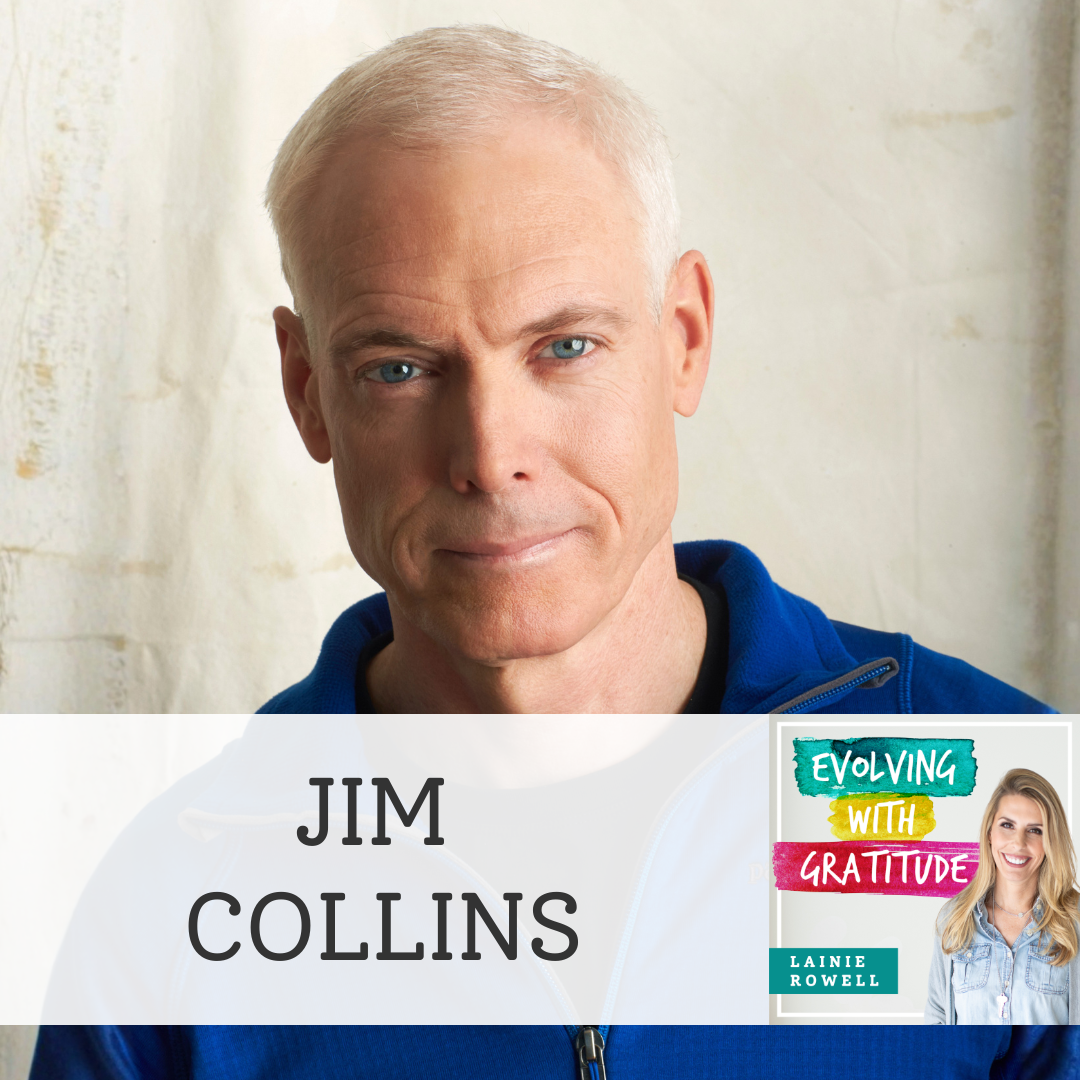
Shownotes:
What if you could decode what truly makes you tick?
In part one of this two-part conversation, I’m honored to talk with Jim Collins, author of multiple international bestsellers, including Good to Great and What to Make of a Life. Jim rarely does interviews, which makes this conversation especially meaningful.
We explore encodings, the deepest intrinsic capacities that shape who we are, what it means to get in frame, and why even doing what we love comes with a cost.
As Jim says, What to Make of a Life is “not a self-help book. It’s a self-knowledge book.”
Thrive Global Article: Jim Collins on What to Make of a Life
About Our Guest:
Jim Collins has published multiple international bestsellers that have sold in total more than eleven million copies worldwide, including the perennial favorite Good to Great. His writings and teachings are based on extensive research projects designed to uncover timeless principles of human endeavor and have had a lasting impact across all sectors of society. All of Jim’s books share a common thread: the study of people and how they navigate the big questions of leadership and life. You can learn more at www.jimcollins.com.
About Lainie:
Lainie Rowell is a bestselling author, award-winning educator, and TEDx speaker. She is dedicated to human flourishing, focusing on community building, emotional intelligence, and honoring what makes each of us unique and dynamic through learner-driven design. She earned her degree in psychology and went on to earn both a post-graduate credential and a master's degree in education. An international keynote speaker, Lainie has presented in 41 states as well as in dozens of countries across 4 continents. As a consultant, Lainie’s client list ranges from Fortune 100 companies like Apple and Google to school districts and independent schools. Learn more at linktr.ee/lainierowell.
Website - LainieRowell.com
Instagram - @LainieRowell
LinkedIn - @LainieRowell
X/Twitter - @LainieRowell
Evolving with Gratitude, the book is available here! And now, Bold Gratitude: The Journal Designed for You and by You is available too!
Both Evolving with Gratitude & Bold Gratitude have generous bulk pricing for purchasing 10+ copies delivered to the same location.🙌
Just fill out the forms linked above and someone will get back to you ASAP!
Transcript:
Transcripts may contain a few typos, so I appreciate your grace in advance!
[00:00:00] Jim Collins: Everyone has encodings. You have encodings. I have encodings. They're different encodings from each other. And we have lots of encodings we'll never discover in a lifetime. It's just the question is, as our lives unfold, which encodings will we maybe even almost accidentally discover through the experiences of life? And the critical thing isn't that I have to find what I'm better at relative to all other people in the world. The critical question is to discover what I'm more encoded for relative to other ways I could spend myself.
[00:00:31] Lainie Rowell: Welcome to the Evolving With Gratitude podcast. I'm your host, Lainie Rowell. I'm an author and speaker, and I'm here to help you optimize happiness, relationships, and performance.
[00:00:42] Hey, friend. What does it mean to live and frame with who we actually are? Today's conversation is a real gift. Jim Collins is the author of multiple international bestsellers, including the perennial favorite, Good to Great, and his books have sold more than 11 [00:01:00] million copies worldwide.
[00:01:02] He has described himself as reclusive by temperament and naturally selective with his time, which makes this conversation an extraordinary honor. In this first part of our two-part conversation, we talk about his new book, What to Make of a Life, the decade of research behind it, what he calls encodings, and even the cost of doing what you love.
[00:01:25] This really is a treat. Enjoy Jim Collins
[00:01:29] Jim Collins: Good morning.
[00:01:30] Lainie Rowell: Good. It's still morning for you?
[00:01:32] Jim Collins: Well I get two mornings actually, so it's 11 o'clock here, so, um, okay. Yeah, and I get two mornings every day anyways. 'cause I nap in the afternoon and then I get a second morning after napping. So I get to say good morning, at about four in the afternoon and anytime up till noon.
[00:01:50] Lainie Rowell: I love it. Well, and I, I'm a big fan of your work, I'm sure that goes without saying, but, I'm super excited to have this conversation.
[00:01:57] Jim Collins: Yeah, and I've been looking forward to our [00:02:00] conversation too, because what we've learned about you is you are always prepared and you are always curious and that will form the basis of a marvelous conversation.
[00:02:10] So I'm very, very much, uh, going to follow your lead.
[00:02:14] Lainie Rowell: Okay. Well, I'm very excited about that and honored that you all would even know that about me. So, yes, I devoured your book. Can I just, nerd out a little bit?
[00:02:25] Jim Collins: Sure. I, I, that would be right in, right in frame for me.
[00:02:28] Lainie Rowell: Okay, good. Um, so this is like,
[00:02:34] Jim Collins: I see many tape flags.
[00:02:36] Lainie Rowell: That's not even all that was underlined. Yeah. And these are like my, my questions for you. But I have to tell you that this has been one of my book trophies for decades.
[00:02:48] And I know we're here to talk about What to Make of a Life, which I absolutely love but I do hope we get a chance to maybe for just a moment or two, dip into the connection to Good to Great. Good to Great came to me at the best [00:03:00] time because I'd been a classroom teacher for years. And then I was offered a district level position, a leadership position, and I had no formal leadership education or anything like that. And as a district, we were reading Good to Great. And it just hit me at the perfect time, so thank you for that. Mm-hmm. And I am 50 and so this is the book that I needed to read at this moment. So just thank you. I know you weren't planning around me, but it felt like you might have.
[00:03:30] Jim Collins: Well, uh, I'm delighted to hear about the impact of Good to Great a pivotal time in your leadership.
[00:03:36] And, uh, and then this one may be coming at a pivotal time in life. 50 is of course, still really quite young, uh, through the lens of this book,
[00:03:44] and I, you know, one of the wonderful things about, uh, the reach of Good to Great is it, it, it did reach into education and, uh, Good to Great in the social sectors.
[00:03:52] The little monograph that went with it, as well as good to great itself, uh, bridged over, even though it was based [00:04:00] on studying you know, what makes great companies tick. Mm-hmm. Because it had that comparative analysis of the good to greats, to the uh, uh, to the comparisons. It really was more about what really separated, uh, the leaders and the people and the decisions that they made to build something really great.
[00:04:17] And I didn't expect it to make as much of a jump, uh, to the non-business sector as it did. Uh, I actually think that maybe as much as half of the readership of Good to Great ultimately was from outside of business.
[00:04:32] Lainie Rowell: I mean, it was just level five leadership
[00:04:35] Jim Collins: mm-hmm.
[00:04:36] Lainie Rowell: Has been a welcome tenet in my brain since the moment I read the book and so it was truly lovely to be reading What To Make Of a Life. Jim, can we like rewind? Because I, I know from reading the book it's 10 years of research, two years of writing.
[00:04:52] Jim Collins: Yep.
[00:04:53] Lainie Rowell: What question were you originally going in here to answer and did that change over time? [00:05:00]
[00:05:00] Jim Collins: Oh, it's a nice question. So, you know, I originally, uh, thought of this as a question about self-renewal because a wonderful mentor wise man by the name of John Gardner had opened my eyes to the question that all of us face it one form or another, which is how do we keep ourselves renewed over, uh, the really long course of a life?
[00:05:22] And, and I was thinking really hard about, well, how would you actually study that? And then what happened is, as I constructed the study itself, and this has happened in all my previous books actually, where I start with a narrower question and then the research method leads to a bigger question. So, uh, back with, uh, Built to Last, way back in the nineties with Jerry Porous, we were studying corporate vision.
[00:05:44] And then it turned out that, uh, we had these match pairs of companies, you know, the visionary company and the comparison company over a hundred years each. And I realized what we really had was trying to figure out what separates, enduring, great visionary companies from the others. And so the, the question [00:06:00] grew here.
[00:06:00] What happened is I had a marvelous method for studying renewal, which was to look at people, pairs of people at these cliff events, these moments where life fractures or changes in some significant way, and you have to re-answer the question of what to make of a life. And by looking at that all, and then how they renewed past it, all of a sudden realized the method gave me a much bigger lens, which is, I could answer, address the big question, what to make of a life when you're coming outta the fog of youth.
[00:06:30] Lainie Rowell: Mm-hmm.
[00:06:30] Jim Collins: What to make of a life when you're hit with a life altering cliff and what to make of a life so that you're renewed all the way till the end.
[00:06:38] Lainie Rowell: Can we talk a little bit about cliffs for a moment? Mm-hmm. By the way, I have a very well prepared list of questions. Sure. And it's never gonna happen because Sure.
[00:06:46] I'm, I'm just gonna ask you questions as I'm, I'm excited to hear about 'em. So, for a cliff
[00:06:52] Jim Collins: mm-hmm.
[00:06:52] Lainie Rowell: it seems like there are some cliffs that you can anticipate. And some cliffs that completely [00:07:00] just come outta nowhere.
[00:07:01] Jim Collins: Yep.
[00:07:01] Lainie Rowell: And so can you just talk a little bit more about cliffs and mm-hmm. Kind of. And, and at one point I do wanna maybe specify a little bit about what a matched pair is for people who might not completely understand that.
[00:07:13] Sure. 'cause the storytelling is riveting in the book.
[00:07:16] Jim Collins: Mm-hmm.
[00:07:16] Lainie Rowell: Like, that is absolutely one of the best teachers in the book mm-hmm. Is your storytelling. But can we talk a little bit more about what cliffs are
[00:07:23] Jim Collins: mm-hmm.
[00:07:24] Lainie Rowell: And the ones you see coming, and the ones you don't,
[00:07:26] Jim Collins: and the ones you don't, and how different those are.
[00:07:28] So, uh, so the, the essence of it, let me just kind of even rewind very briefly the tape of where the cliff idea came from. It came from a, a, a deeply painful personal moment in my life and my wife's, Joanne's life. And she was a, a world class athlete. She was a world champion athlete, had won the Hawaii Ironman in 1985 and, and then had a hamstring injury that never healed and she faced the brutal reality that her athletic career was going to come to a, a premature [00:08:00] conclusion because this injury simply would not heal. And one day we were sitting around our kitchen table in, uh, in Palo Alto where we lived at the time, and she just gasped.
[00:08:09] I feel like I'm dying. And, and it was a really painful moment. Of course for her, it was very painful to lose that identity of being an athlete, a world class athlete, to something that was out of her control, the injury. Uh, but for me it was really painful because I had no answer for her, right? She was the most important person in my life and she felt like she was dying with this end of this definition of her.
[00:08:33] And that's what really planted the seed of, you know, there come these times in life where something changes in your life, something so significant changes in your life that it forces really significant questions about what's next. And sometimes even having to recast and completely re-envision your life coming out of the cliff.
[00:08:50] And so that's the seed of where, where cliffs came from and what cliffs are about. Your question about sometimes you can see the [00:09:00] cliffs coming and sometimes you can't. So if you look at, say, our athletes in the study, uh, such as we had NFL football players, uh, their, their life as professional athletes will come to an end at some point, and they know that the cliff is inevitable.
[00:09:15] It doesn't mean it's easy, but you can see it coming. And so, or Alice Paul and Lucy Burns who were, who were fighting for women's suffrage. Uh, and the cliff in their case was they won, which then left them the question of what to do with the rest of their lives. But the, uh, but they could see that they were beginning to build enough momentum that they might well win, and that would be a cliff, meaning they'd have to redefine their lives.
[00:09:38] But then there's the shockingly unexpected ones. So one of the pairs in the study, as you know, is Cardiss Collins and Maryon Pittman Allen, and the cliff they're matched at is the death of their husbands. Uh, one died in a plane crash and the other died of a heart attack. Neither of them saw that coming.
[00:09:54] And uh, and then they were not only faced with the cliff of losing the defining person in [00:10:00] their life, they were also, they inherited their husband's seats in Congress, which they had never prepared for. So they got kind of a double cliff, which is, I never saw myself as a Congress person, and now I've lost my husband.
[00:10:14] And I have his seat in Congress. I never expected to be here. And those shocking out of the blue cliffs that just hit you, those ones tend to, to, uh, have a, not a different pattern, but much thicker fog after the cliff.
[00:10:29] Lainie Rowell: You talk about in the book the different types of fog, and we can get into that, but is it okay if we back up for a minute?
[00:10:35] Jim Collins: Yeah, sure.
[00:10:35] Lainie Rowell: And talk about the matched pairs, because I feel like someone who hadn't read the book and I heard this conversation and didn't truly understand the significance of the matched pairs, yes. I think it would be, um, it would be a disservice. Yeah. . So please tell us, yeah. Why is this so important?
[00:10:49] Jim Collins: Yeah. So I've always used match pairs in my research where I like to take pairs of, in the, in the past, in my prior work and say, Good to Great.
[00:10:58] It would be like pairs [00:11:00] of companies that were at the same time and same resources, same potential, same opportunities at a given moment in time. And then, you know, one would break out and the other wouldn't. And so their circumstances were somewhat constant, but their. Sort of choices and decisions coming out of it were different.
[00:11:16] And then I could compare and contrast, and that was the methodology behind Built to Last to Great, Great by Choice, How the Mighty Fall, all those, all those books. So when I came to studying people, I also felt it'd be powerful to have people who were facing a very similar circumstance, but then would make very different choices coming out of it.
[00:11:33] And I could compare and contrast. And so for example, you could take a look at, well, let me just back up for a moment. I wanna be really clear about one very important difference between this study and those who might know my prior work.
[00:11:45] My wife Joanne came in as I was getting deep into this research one day and she said to me, remember Jim, people are not stock returns.
[00:11:54] And what she meant by that is that whereas when I'm studying companies, I can [00:12:00] really, you know, determine which company was better than the other company.
[00:12:03] Lainie Rowell: Mm-hmm.
[00:12:04] Jim Collins: Here I'm not using match pairs to say that one person was better than another person. I'm looking at how they were different. Their Cliff was the same.
[00:12:13] End of NFL career winning the 19th amendment, death of husband, whatever. Right? And their choices were different. But it doesn't mean, so in the other studies it was always this one better than that one. In this study it's two people rising, hit a cliff and then they diverge. But you couldn't say this one's better than that one.
[00:12:31] And, uh, and we can pop back to that, but lemme just pause there for a moment because, uh, you, I'd love to help people see the power of having those pairs, but let me just give you a chance for your curiosity to go with that.
[00:12:44] Lainie Rowell: Well, it was more just a comment that sprung into my mind is just throughout the book, you're so careful
[00:12:50] Jim Collins: mm-hmm.
[00:12:50] Lainie Rowell: to make sure that people don't think you're saying judgment wise, right. This one was better than this one, but you've picked people who've had [00:13:00] significant contributions. Yeah. and watched how their story has unfolded, and we will, we'll get into encodings, but it was just an observation mm-hmm.
[00:13:08] That it is such a nuanced but important thing to think about. No, we're not judging these people. We're observing and we're noting and we're seeing these things to, to illustrate a point.
[00:13:20] Jim Collins: That's exactly right. And, and so just to, to help you know, your, your listeners grasp this, if you take, for example, uh, one of the opening pairs is in the second chapter of the book where I finally get into looking at, you know, concepts and then pairs to illustrate them.
[00:13:35] Uh, two women in science, Barbara McClintock and Grace Hopper. And, uh, they both illustrate, uh, how, uh, when you put 'em side by side, really important lessons and yet they do it in very different ways. So. Uh, their cliff was, they were women in science, Barbara McClintock as a, as a pioneering geneticist who, uh, eventually won a Nobel Prize and Grace Hopper, who was early in the development [00:14:00] of computers and essentially was the champion for making computers really useful through software, but both of them faced the cliff that they couldn't continue doing their scientific work within the confines of a traditional university in the era in which they were women in science, which was the first half of the 20th century. So their cliff was, they had to find a different way.
[00:14:20] They had to re-envision their life so that they could continue to do the work that was so important to them. But what's so interesting when you look at these two, they're, they're both, their lives are so parallel, different, slightly different fields, but so parallel to the point of this cliff in terms of discovering an arena in which to deploy themselves.
[00:14:38] And both of them found something that we'll chat about in a minute, that they were deeply encoded for. Both of them didn't do it for the money that to, to them money was a, there as a means to do what they were really encoded for. And they both really focused their inner fire on making it happen.
[00:14:53] But then when you look under the surface, so that's common. Yeah. But what's different is how different they brought [00:15:00] that to life because Barbara McClintock was this solitary scientist who love to work alone and get lost in her maize fields. And even the day she won the Nobel Prize, she didn't even have a telephone.
[00:15:11] They couldn't even call her. And, you know, when they finally found her, she was out on a walk like picking walnuts and, and she just was just this, just, and just burrowing ever deeper and studying the control of genes and, and, and love the freedom to just work alone. From Grace Hopper, she's over here advancing computer science, but she worked through institutions and people.
[00:15:32] She was in the Navy. She was, uh, one of the, uh, early pioneering leaders in building a team of software designers at a company. And, and she was a tremendous, she had tremendous codings for organizing people inside institutions to really advance the cause of computers. And that was a brilliant set of encodings that she had.
[00:15:52] And so both of them share in common. They're encoded for it. They focus the fire on it. They didn't do it for the money. [00:16:00] The money was there to help them do what they were encoded for. That was common. But then you look at how different the people are.
[00:16:07] Lainie Rowell: Mm.
[00:16:08] Jim Collins: And by putting them side by side, you realize that the critical thing was there wasn't a single recipe book of like, do these 10 steps because.
[00:16:18] In the end, they were encoded so differently from each other that the way they made choices that worked for them reflected those encodings. And hence, one of the critical things to take away when this is what the match pairs really show you, is it's not, you should try to do what Grace Hopper did. And it's not, you should try to do what Barbara McClintock did.
[00:16:38] It's that what you should do is to do what they did, which is to trust their own encodings, which were idiosyncratic to them.
[00:16:47] Lainie Rowell: Absolutely. Okay. You queued me up perfectly to talk about encoding, so I would love for you to explain what encodings are mm-hmm. And what they aren't. Mm.
[00:16:56] 'cause I think people will bring their own [00:17:00] experiences and knowledge to, if they hear the word encoding without a description and they're gonna think, oh, it's strengths, oh, it is intellectual genius. Or things like that. So I, I'm just gonna ask you to share what it is and what it isn't like.
[00:17:13] I speak and write about Gratitude a lot, and so I like to tell people what it is and what it isn't like. Gratitude isn't about ignoring what's hard. It's about refusing to overlook what's good and there's a difference. So what would be your version of that for encoding?
[00:17:26] Jim Collins: So, uh, encodings as I came to understand them are these like durable capacities that reside inside us and awaiting discovery through the experiences of life. Yeah. So I can, I can train myself to be strong at something, but it isn't necessarily a deep capacity that when activated, would really shine bright relative to other ways in which I could expand myself. I'll just use a personal example of this, I have a strength at mathematics because I worked really hard at math. I majored in math [00:18:00] sciences in college and, and so, okay, I can do differential equations, but that's a strength that I have because I've met people and I met them in college who were actually really encoded for math.
[00:18:13] Right. It was really natural for them. It just really clicked for them. And so while I turned math into a strength through sheer hard work and will, they had a more natural encoding for math. And as a result, I had to find other things in life that are actually more deeper intrinsic, durable capacities that I could express.
[00:18:33] And so I've got a strength in math, but math isn't what I'm really encoded for, which is to research and to write and to teach and so forth. And so we can all develop strengths, things that we can become strong at just like you can, you know, you can build muscles by training, right? But that doesn't necessarily determine whether you would be encoded to be, say, a distance runner.
[00:18:56] Lainie Rowell: Yeah.
[00:18:56] Jim Collins: Uh, versus say a middle linebacker, right? You both could get stronger [00:19:00] with your muscles, but in one role, you're really well encoded. In another role, you're really not well encoded. And, and so that distinction between encodings, which you discover versus strengths, which you kind of add by, by training and work and discipline.
[00:19:15] Uh, the other thing about the, the encodings I wanna highlight, you use this notion of genius. Everyone has encodings. Mm-hmm. Everyone has encodings and there are more encodings than any of you have encodings. I have encodings. They're different encodings from each other. And we have lots of encodings.
[00:19:30] We'll never discover in a lifetime. It's just the question is, as our lives unfold, which encodings will we maybe even almost accidentally discover through the experiences of life? And the critical thing isn't that I have to find what I'm better at relative to all other people in the world. The critical question is to discover what I'm more encoded for relative to other ways I could spend myself.
[00:19:56] Lainie Rowell: So how would you say, 'cause you talk in the book about being [00:20:00] in frame.
[00:20:00] Jim Collins: Yes.
[00:20:01] Lainie Rowell: So are there ways that we can actually look for these encodings?
[00:20:05] Mm-hmm. Like what is the best way to get into frame for that?
[00:20:08] Jim Collins: So let's, uh, briefly discuss what it means to be in frame and then, uh, and then I'll, we'll can chat a little bit about this. Sometimes serendipitous, sometimes maybe deliberate process of discovering these things. But the way I sort of think of it is picture, um, think of it is that you have a constellation of encodings and they're a little bit like, they're like stars, right?
[00:20:30] And, and in a constellation. And, and the stars are always out there. And at any given moment though, maybe there's a window frame that you can look through out to that constellation. And, uh, and that might be where your life is at a given point. And then when you look through that window, if the window frame is say, over here and not capturing a lot of the constellation.
[00:20:51] There aren't many of those encodings coming in through the window. You're sort of out of frame. And if it's uh, another time, it's capturing a big, [00:21:00] bright set of those encodings with what you're doing. You're in frame. So if you take John Glenn, who we write about in that chapter, the astronaut, well test pilot, fighter pilot astronaut and so forth. His initial steps in life, he was studying chemistry. He was you maybe gonna be a doctor, but it didn't really click for him. It's like the frame was over here. He tried sports, it wasn't really clicking as much. And then through a serendipitous couple of things, he ended up being able to get a pilot's license.
[00:21:29] And as soon as he got in an aircraft, it was like the frame shifted.
[00:21:34] Lainie Rowell: Yeah.
[00:21:34] Jim Collins: And click. Those encodings came through the frame and he felt incredibly natural. His comparison or match a companion, it's not a comparison match pair companion in the study, Gordon Cooper described flying as his truest element.
[00:21:49] What he meant by that was what you could feel like, almost like wear the aircraft like a glove and this incredible instinct for being calm in situations of great danger and of great speed and [00:22:00] able to slow time down. All these things that were so intrinsic to being a great fighter pilot, great test pilot, great astronaut.
[00:22:07] And that was when John Glenn was in frame. Then after his astronaut career, he spent a decade before he ended up in the Senate, which was a second version of being in frame at Royal Crown Cola, about 10% of his life. But it only was 0.2% of his memoir. And what I draw from that is that he still John Glenn, but those times when he was a business executive, I'm sure he was fine at it.
[00:22:32] Mm-hmm. But he wasn't the same way he was as a fighter, pilot, astronaut, or a senator. There were just fewer encodings coming through the window, so he was more out of frame and for all of us then life kind of is this shifting the frames in life. And the key is that when you begin to see that the window is capturing the encodings, and I think this is the critical word, you trust them.
[00:22:56] Mm. And I think it's about when you get [00:23:00] clues and you're getting clues all the time, you trust them when they begin to click, as opposed to letting somebody talk you out of them, whether that be a commencement speaker or whether that be a parent or a mentor or a professor or whoever. They might have wonderful advice for you, but it's based on their encodings and they're not the same as your encodings.
[00:23:23] Lainie Rowell: Mm, you opened the door on the parenting. So I kind of wanna explore that for a minute because I do think there's so much nuance in these things, and I do think there's an interesting thing as a parent. I have a 15-year-old Mm. And a 12-year-old. I'm, I'm sure people joining us in this conversation have young people around them.
[00:23:39] And I think it's difficult. We want to encourage looking for those encodings. Mm-hmm. And I think the trusting yourself is a really, really good thing because we don't wanna narrow too much and miss what could have been in frame.
[00:23:55] So I'm kind of curious as to like, for ourselves or for the people that we care [00:24:00] about, how do we help nudge them to find the thing that will put them in frame?
[00:24:05] Jim Collins: Yeah.
[00:24:07] Lainie Rowell: Versus,
[00:24:07] Jim Collins: sorry, I, I'm gonna ask you a question about this, but first I think what's really fascinating to me when I look across the lives in the study.
[00:24:15] And the, the thing that made this study so big was I was looking across, wasn't just looking at episodes right? I was looking at cross in the case of those who are no longer with us, which is most of the people in the study their entire lives. And, uh, most of the others are, uh, the, the remaining ones are really quite far along most of their life is in the record books.
[00:24:35] And when you look over the long arc, you can see that even the same people right. John Glenn is still John Glenn. Yeah. But in these different phases of life, he's either out of frame or in frame, out of frame, studying chemistry. Relative to in-frame flying fighter jets.
[00:24:51] Yeah. Relative to less in-frame being a business executive, back to more in frame as a senator. Yeah. Then run for president. And [00:25:00] that's sort of more out of frame. And then he comes back, you know, to really refocus on the Senate and actually goes back to space again and in his seventies and he's fully back in frame.
[00:25:09] And so you see these sort of times of life when you're in frame and times of life when you're out of frame. And first of all, I think that that's for me, uh, a, a great relief to know that it's not like there's something wrong with you when you're out of frame. You're just out of frame at that time. And, uh, and that and that.
[00:25:29] Even the same person all of us may have periods of life when we're in frame and periods of life, when we're out of frame. And, uh, and that, that's a pretty consistent experience with many of the people that I studied, uh, in this book. And, and that's just a relief 'cause it's not like they had a perfect record of at age eight, they were in frame and then everything just was perfect.
[00:25:51] It, it didn't always work like that. But I, I wanna come back to you on something. I think one of the really interesting things that I thought about, and as the study grew in my [00:26:00] mind, I began thinking about younger people. Hmm. I originally thought about those of us who are looking at the second half of life and how to keep it really renewed, remaining in frame and all that.
[00:26:11] But I began to see, 'cause I looked at how all these people got in frame early in life, and I think there is this thing of the fog of youth. Uh, I, I didn't really come into frame until my thirties, about age 30. In my twenties I was very much in the fog of youth. Uh, I, you would not, uh, I, I mean, it's a very foggy period, but as a parent and you think you, you, you have young people coming.
[00:26:34] How did you think about this as you were reading? How did you read and think as a parent and how did you read and think, in terms of, of this question of the fog of youth, which seems, it certainly happened for a number of the people in our study as well.
[00:26:51] Lainie Rowell: Yeah. So I love that question and I love that you're so curious and that you would be kind enough to ask me a question.
[00:26:57] I don't think I explicitly thought of the word trust, but I [00:27:00] will take it back to the word trust and that
[00:27:01] Jim Collins: Yeah,
[00:27:02] Lainie Rowell: I mean, there's such a lovely, and, and we'll get to it about like there's no like peak at 30 or anything like that. Mm-hmm. Right? Like, there's still a lot, a lot to do, but I think it would
[00:27:12] Jim Collins: even at 60 and at 80,
[00:27:15] Lainie Rowell: I know, I, I mean that's like, we have to talk about that.
[00:27:17] Yeah. Uh, so I wanna make sure we get to that. But as a parent,
[00:27:20] Jim Collins: yeah.
[00:27:20] Lainie Rowell: It helped me think this isn't like, my child is interested in this and this is what they'll do the rest of their life, or they're not good at this that's, that's gonna be hard for them. No, there's gonna be other things they're gonna be good at.
[00:27:33] Mm-hmm. So I think as a parent and just someone who's around young people, it just really helped me think about there's a long way to go here, and there's going to be things that they discover they like and they don't like, and they'll be in frame and they'll be out of frame. And so
[00:27:49] it's a stress reliever in a way.
[00:27:50] Jim Collins: Yes.
[00:27:51] Lainie Rowell: It kind of lowers the anxiety, the stakes are not as high as you think they are.
[00:27:55] Jim Collins: Yeah. This great exhale is sort of what I, I felt as I studied [00:28:00] them and I would, I would share a, a couple things with this that picking up on what you said. You know, it's really interesting.
[00:28:06] Some of our people found their first in, in frame really quite early. But I take a look at one of my favorite stories in the book comes in the fog of youth section of the book, which is in, uh, the fog chapter, chapter seven, and it's about Alice Paul. And, you know, here's Alice Paul, who became this monumental, utterly focused, fire filled exceptional leader and was the strategic architect for getting the 19th Amendment done. And you would not want to compete against Alice Paul because you would lose. I mean, it's just, she was just an amazingly well encoded, uh, leader of the fight. Now, what's interesting about Alice Paul is you would think that, well, she must have like known this when she was really young at age 14.
[00:28:48] She's already like, you know, wanting to go out and do this, but when you actually look at her her entire twenties, she's pinging around, she's starting to get clues, and when she ends up in England, she ends up marching in a march with the suffragists and [00:29:00] meets Lucy Burns in a jail. Uh, and that kind of starts the process.
[00:29:03] But there's this zigzagging, right? She's over in biology and sociology and studying economics and all this different stuff. She looks lost, and yet then when she finally clicks into frame and these encodings for the strategy that she had. And this is using coatings for creating spectacles of protests, which she had.
[00:29:27] When those finally clicked into frame, then bang, you can see it. But what I take from that is that it took her years to get there.
[00:29:35] Lainie Rowell: Yeah.
[00:29:35] Jim Collins: And so kids may be figuring it out. They may look lost, but that doesn't mean they're not Alice Paul. Right. When, when they click and frame. And, and the other, and the other piece of it is just this notion of, uh, there's, there's this idea that you gotta find, you know, the thing you're made for.
[00:29:53] But one of the wonderful releases to me of the study is because of the cliffs where you see people have one. [00:30:00] Form of life, definition of what they were doing. Maybe come to an end. I was a football player. Well, now I'm over here, you know, as a Supreme Court justice in the state of Minnesota, like Alan Page, or someone like Katharine Graham, who's husband, uh, she lost her husband, uh, to the disease of manic depression.
[00:30:18] She ended up running the Washington Post. She didn't even know she had leadership ings will until that experience exposed them and made her one of the great CEOs of all time. And so what I came to understand is that you can move you. There isn't one thing you're made for and you just hope you find it.
[00:30:36] Rather, there are multiple possibilities of what you were encoded for. And even if you don't discover nine of 10 of them, it doesn't matter so long as you find one of them.
[00:30:49] Lainie Rowell: Mm-hmm.
[00:30:50] Jim Collins: And to know that it is a multi. Set of possibilities rather than, oh gosh, there's just this one. I find that a [00:31:00] tremendous relief and I would've loved to have known that when I was 25.
[00:31:03] Lainie Rowell: Mm. I'm 50 and I'm so happy to hear it. Yeah. So you're making me think of, the stress and drudgery tax.
[00:31:12] Jim Collins: Yes.
[00:31:13] Lainie Rowell: And where I'm coming to that from is thinking about how you wanna be paying it for the right thing.
[00:31:21] Jim Collins: Mm-hmm.
[00:31:22] Lainie Rowell: And how do you know when you're. Paying it for the right thing.
[00:31:26] Like there's just gonna be things that we all do no matter if we're doing the thing we're most encoded for, or one of the things we're most encoded for. Yeah. It's like how do we know if we're paying the stress and drudgery tax for the right thing or not? Mm-hmm.
[00:31:40] Jim Collins: So, so this, this is actually sort of ties into to two things that I think are, uh, that I just wanna highlight as we, as we talk about this.
[00:31:48] So one of the is kind of fully being in frame, of course has you're in frame with your encodings, and then there's these other two pieces, which is one is that, money is to help you be able to do what you're encoded for [00:32:00] rather than the purpose of my work is to make money. Right. That's the flip of the arrow of money.
[00:32:04] And we have a whole chapter on that and how they did it practically. And then this notion of focusing the inner fire and part of the inner fire is that, uh, there's a certain compulsion, a love of what you're doing that really, uh, al almost, you can't not do it. Mm-hmm. But then there's sort of these two really practical dimensions of this when you study the lives. 'cause you could take away, I think what would be a wrong lesson, which is say, I'm just gonna do what I love and everything will work out well. It's actually not exactly the way life works. One on the economic side.
[00:32:33] Lainie Rowell: Mm-hmm.
[00:32:34] Jim Collins: Uh, they were very practical people that they had to make their economics work and most of them didn't come from family wealth.
[00:32:40] And so it's not do what you love, the money will follow. It's do what feeds the fire, which you probably do love doing the actual doing of it.
[00:32:49] Lainie Rowell: Yeah.
[00:32:49] Jim Collins: And you have to be very smart and practical about how you make the economics work to be able to do it. Mm-hmm. And, and it's very different [00:33:00] thing that the money will fall.
[00:33:01] I love to ride my bike. Nobody's gonna pay me to do it. Right. I mean, so that's, so that, that's one. And we have a whole bunch on that. But then the second part is even if you're doing something that you are so on fire to do. You're fighting for the 19th Amendment. You're playing guitar like Jimmy Page, you're flying fighter jets like John Glenn, right?
[00:33:21] You're doing surgery or skating like Tenley Albright, which are all, all, all these wonderful people in the study. You would sort of think, well, it's all just this blissful, soaring through the air. Well, all of them paid this tax, which is no matter how much you love what you're doing, no matter how much it feeds the fire, no matter how encoded you are for it, there's the stress and drudgery tax.
[00:33:43] No one escapes it.
[00:33:45] Lainie Rowell: Mm-hmm.
[00:33:46] Jim Collins: And you basically have this choice, am I gonna be creatively, intensely engaged in life? And if you are, you're gonna pay the tax. Mm-hmm. And how, and, and it's not taxed in terms of I have [00:34:00] to pay tax over here to do this over here that I love. You pay the tax in doing what you love.
[00:34:05] And that, that's why we have, um, wonderful examples of that. And then they can be little things like. Uh, I mean, it can be big things like I am pay. When he was, you know, architecting, he always had this stress around the initial designs. He described it as traumatic for his wife. He would like, he couldn't sleep.
[00:34:23] He was, you know, and, and then when he would have controversial designs, he would have to deal with the stress of people approving them. And when he did the Louvre Pyramid, people were spitting at his feet in the streets. And it's, it was wonderful to be an architect that could do that. But he still had the stress and drudgery tax and, and it comes, different people have different things that cause the stress and drudgery.
[00:34:44] Katharine Graham
[00:34:46] Lainie Rowell: mm-hmm.
[00:34:46] Jim Collins: Always felt that the notion of like giving the internal talk at the Christmas party would actually fill her with dread to have to do that. Uh, and, and so that was part of the stress and drudgery [00:35:00] text of being the CEO of the Washington Post.
[00:35:03] Lainie Rowell: So correct me if I'm wrong.
[00:35:05] Mm-hmm. But everyone's gonna pay a stress and drudgery tax.
[00:35:08] Jim Collins: Yep.
[00:35:09] Lainie Rowell: There's parts of the process you might not love. That does not mean you should abandon the process.
[00:35:13] Jim Collins: That's right. That's right. So, I mean, I'll just speak personally on this. I really love doing my research. Mm-hmm. Uh, I love making sense of the world. I can be lost for hours in my creative chair, you know, learning about whether it be the companies or the, the, the people I studied in this study. I love making sense of what all the data means in constructing frameworks.
[00:35:35] And I love teaching it and helping people understand it now in order to, uh, have the entire system work and to ultimately have an impact with the work, which is part of how my own flywheel works, uh, I also have to out and teach it. And I love the teach. I do not love being on airplanes.
[00:35:53] Lainie Rowell: Yes.
[00:35:54] Jim Collins: I mean, I really don't.
[00:35:55] Um, I find, I find some people love to travel. I find travel to be [00:36:00] stress and drudgery, and I find, you know, it's just this tax I, I pay, I willingly pay it to be able to teach in settings that feed the flywheel and, and really allow me to share my ideas and to have the work have impact. But it doesn't change the fact that every time it's, you know, it's, it's Monday night and I'm leaving on Tuesday and I've gotta get stuff ready to go and I'm packing it's stress and drudgery.
[00:36:25] It just is. And, and so I can either, I could quit, but why would I quit when I still want to do this until I, I can't do it anymore? And that's the stress and drudgery tax, it just comes with the game.
[00:36:39] Lainie Rowell: Okay. I'm curious if it would be a good time to talk about the bug book.
[00:36:43] Jim Collins: Oh, yes. The bug book.
[00:36:45] Lainie Rowell: Because I do feel like this is a very practical way Yeah.
[00:36:48] Yes. That you have figured out. Yeah. Is the stress and drudgery, I mean, do, do you make that? Am I making that connection outta nowhere or
[00:36:55] Jim Collins: connect? Yeah. So there's, so there's two parts. Let's break this into two parts...
[00:36:59] Lainie Rowell: Actually, [00:37:00] Jim, that's a brilliant idea. Let's break this into two parts. And this is the perfect place to pause, so we'll pick up from here next time.
[00:37:07] If you're grateful for this episode, please be sure to subscribe today. And if you're feeling really thankful, please submit a review and share with others so they know the value. One last thing, please connect on social media using the hashtag EvolvingWithGratitude to share your gratitude stories.